
Essential Data Security Controls Every Organization Should Implement
In an era where data breaches make headlines almost weekly, the question isn't whether your organization will face security threats, but when. The 2023 IBM Cost of a Data Breach Report revealed t...
Introduction
In an era where data breaches make headlines almost weekly, the question isn't whether your organization will face security threats, but when. The 2023 IBM Cost of a Data Breach Report revealed that the average cost of a data breach reached $4.45 million, with some incidents costing organizations tens or even hundreds of millions of dollars. Beyond the financial impact, data breaches erode customer trust, damage brand reputation, and can result in severe regulatory penalties.
Data security controls are the defensive mechanisms that organizations deploy to protect their information assets from unauthorized access, disclosure, modification, or destruction. These controls form the backbone of any robust cybersecurity strategy, creating layers of protection that make it exponentially more difficult for attackers to succeed.
Whether you're a small startup handling customer email addresses or a large enterprise managing millions of financial records, implementing fundamental data security controls isn't optional—it's essential for survival in today's digital landscape. This comprehensive guide will walk you through the critical security controls every organization should implement, regardless of size or industry, providing you with actionable knowledge to protect your most valuable asset: your data.
Core Concepts
Understanding Security Controls
Security controls fall into three primary categories, each serving a distinct purpose in your defense strategy:
**Preventive Controls** stop security incidents before they occur. Think of these as locks on doors—they create barriers that prevent unauthorized access. Examples include firewalls, encryptionEncryption🛡️The process of converting data into a coded format that can only be read with the correct decryption key., access controls, and authentication mechanisms.
**Detective Controls** identify security incidents while they're happening or shortly after they occur. These function like security cameras and motion sensors, alerting you to potential problems. Log monitoring, intrusion detection systems, and security audits fall into this category.
**Corrective Controls** minimize the impact of security incidents and restore systems to normal operation. These are your incident response plans, backup and recovery systems, and patchPatch🛡️A software update that fixes security vulnerabilities, bugs, or adds improvements to an existing program. management processes.
The CIA Triad
At the foundation of data security lies the CIA Triad, representing three fundamental principles:
**Confidentiality** ensures that sensitive information is accessible only to authorized individuals. This involves implementing access controls, encryption, and data classification schemes.
**Integrity** guarantees that data remains accurate and unmodified except by authorized parties. Hash functions, digital signatures, and version control systems protect data integrity.
**Availability** ensures that authorized users can access information when needed. Redundancy, backup systems, and disaster recovery planning maintain availability.
Defense in DepthDefense in Depth🛡️A security strategy using multiple layers of protection so that if one layer fails, other layers continue to provide security.
No single security control is perfect. The defense-in-depth strategy implements multiple layers of security controls so that if one fails, others remain to protect your data. Like a medieval castle with a moat, walls, and an inner keep, your data security should have multiple protective layers working together.
The Principle of Least Privilege
This fundamental security concept dictates that users should have only the minimum access rights necessary to perform their job functions. Overprivileged accounts represent one of the most common vulnerabilities exploited in data breaches.
How It Works
Access Control and Authentication
Access control determines who can access what resources within your organization. This works through several mechanisms:
**Authentication** verifies user identity. The most basic form is username and password combinations, but modern security demands stronger approaches. Multi-factor authentication (MFA) requires users to provide two or more verification factors—something they know (password), something they have (phone or security token), or something they are (biometric data).
When a user attempts to access a system, the authentication process unfolds in stages. First, the user presents credentials. The system validates these credentials against stored values (typically hashed and salted passwords). If MFA is enabled, the system requests additional verification. Only after successful authentication does the system grant access according to the user's authorization level.
**Authorization** determines what authenticated users can do. Role-based access control (RBAC) assigns permissions based on job functions. For example, a marketing employee might have read access to customer contact information but no access to financial records, while an accountant might have the opposite permission set.
Encryption Implementation
Encryption transforms readable data into ciphertext that appears as random characters without the proper decryption key. This protection works in two primary contexts:
**Data at Rest Encryption** protects stored data on hard drives, databases, and backup media. When you encrypt data at rest, even if someone steals the physical storage device, they cannot read the information without the encryption key. Full-disk encryption tools encrypt entire hard drives, while database encryption protects specific sensitive fields within database tables.
**Data in Transit Encryption** protects information moving across networks. Transport Layer Security (TLS) creates encrypted connections between clients and servers, ensuring that data intercepted during transmission remains unreadable. When you see "HTTPS" in a web address or your email client establishes a secure connection, you're witnessing data-in-transit encryption in action.
The encryption process involves sophisticated mathematical algorithms. Modern encryption standards like AES-256 use 256-bit keys, creating 2^256 possible combinations—a number so large that brute-force attacks would take billions of years using current technology.
Network Security Controls
Network security controls create protected perimeters around your data:
**Firewalls** examine incoming and outgoing network traffic, blocking communications that don't meet defined security rules. Next-generation firewalls go beyond simple port filtering to perform deep packet inspection, identifying and blocking sophisticated threats.
**Network Segmentation** divides networks into isolated zones, limiting lateral movementLateral Movement🛡️Techniques attackers use to move through a network after initial compromise, seeking additional systems to control and data to steal. if attackers breach one segment. A properly segmented network might separate guest WiFi, employee workstations, servers, and sensitive data storage into different network zones, each with controlled communication pathways between them.
**Intrusion Detection and Prevention Systems (IDS/IPS)** monitor network traffic for suspicious patterns. IDS systems alert security teams to potential threats, while IPS systems can automatically block malicious traffic.
Endpoint Security
Endpoints—laptops, desktops, mobile devices, and servers—represent common attack vectors. Endpoint security controls protect these devices:
**Antivirus and Anti-malware Software** scans files and programs for known malicious code patterns. Modern endpoint protection platforms use behavioral analysis and machine learning to identify previously unknown threats.
**Endpoint Detection and Response (EDR)** provides continuous monitoring of endpoint activities, recording system events to detect suspicious behavior and enable rapid incident response.
**Patch Management** systematically updates software to fix security vulnerabilities. Attackers frequently exploitExploit🛡️Code or technique that takes advantage of a vulnerability to cause unintended behavior, such as gaining unauthorized access. known vulnerabilities in outdated software, making timely patching critical.
Real-World Examples
Example 1: Healthcare Organization Implements Encryption
A mid-sized healthcare clinic with 15,000 patient records faced HIPAA compliance requirements and increasing ransomware threats. They implemented a comprehensive encryption strategy:
Six months after implementation, an employee's laptop was stolen from their vehicle. Because the device used full-disk encryption with a strong password, the organization determined that no patient data was compromised. They avoided a reportable breach, potential HIPAA fines, and the reputational damage associated with exposed patient records. The cost of implementing encryption ($15,000) was minimal compared to the average $10.93 million cost of healthcare data breaches.
Example 2: Financial Services Firm Adopts Zero TrustZero Trust🛡️A security model that requires strict verification for every user and device trying to access resources, regardless of whether they're inside or outside the network perimeter. Architecture
A regional investment firm managing $2 billion in assets recognized that their perimeter-based security model was insufficient. Employees increasingly worked remotely, accessing systems from various locations and devices. They implemented a zero trust approach:
Within the first year, their security monitoring detected and blocked 27 credential-based attack attempts that would have succeeded under their previous security model. The continuous authentication system identified compromised credentials being used from an unusual location and automatically terminated the session before any data was accessed.
Example 3: Retail Company's Backup Strategy Defeats Ransomware
An e-commerce retailer with annual revenue of $50 million fell victim to a ransomware attack that encrypted their primary systems, including customer databases, inventory management, and financial records. The attackers demanded $250,000 in cryptocurrency.
However, the company had implemented a robust backup and recovery strategy:
When ransomware struck, the IT team immediately isolated affected systems, preventing spread. They verified that backups were intact and unencrypted. Within 36 hours, they had restored all critical systems from backups, losing only eight hours of transaction data. They refused to pay the ransom, reported the incident to law enforcement, and resumed normal operations. The total
Related Reviews
REOLINK 4K Security Camera System Review: Professional PoE Surveillance at DIY Prices
The REOLINK 4K PoE security system delivers 8MP clarity, smart person/vehicle detection, 24/7 recording with 4TB storage, and plug-and-play installation for comprehensive home surveillance.
Ring Outdoor Cam Pro Review: 4K Security Camera with Radar-Powered Motion Detection
The Ring Outdoor Cam Pro delivers Retinal 4K video, 10x enhanced zoom, Low-Light Sight for true color night vision, and radar-powered 3D motion detection for precise security alerts.
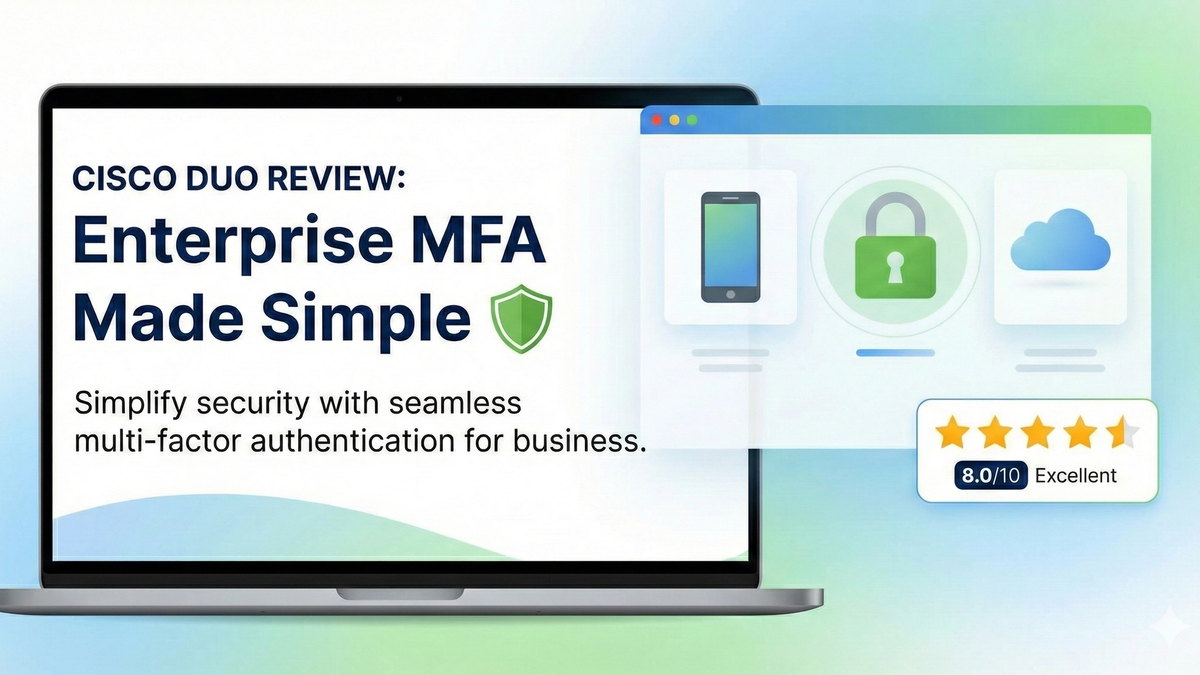
Cisco Duo Review: Enterprise MFA Made Simple
Cisco Duo delivers robust multi-factor authentication with one of the smoothest user experiences in the enterprise MFA space. While pricing can escalate quickly for larger teams, its device trust and adaptive policies make it a solid choice for security-conscious organizations.