How Personal Health Information Is Stored and Protected
Every time you visit a doctor, fill a prescription, undergo a medical test, or use a health tracking app, you create personal health information (PHI). This data forms a comprehensive digital por...
Introduction
Every time you visit a doctor, fill a prescription, undergo a medical test, or use a health tracking app, you create personal health information (PHI). This data forms a comprehensive digital portrait of your medical history, current conditions, treatments, and sometimes even your genetic makeup. Understanding how this sensitive information is stored and protected isn't just a technical curiosity—it's essential knowledge for anyone who wants to maintain control over their privacy and security in an increasingly digital healthcare landscape.
Personal health information is among the most sensitive data we generate throughout our lives. Unlike a stolen credit card number, which can be cancelled and replaced, your medical history is permanent. Once compromised, PHI can be used for identity theft, insurance fraud, employment discrimination, or even blackmail. The stakes are high: according to the U.S. Department of Health and Human Services, healthcare data breaches have affected over 300 million individuals in the United States alone since 2009.
This article will demystify how healthcare organizations store and protect your personal health information, explain the regulations that govern this data, examine real-world security implementations, and provide actionable guidance for protecting your own health information. Whether you're a patient trying to understand your rights, a healthcare professional seeking to improve your practice's security, or simply a privacy-conscious individual, this comprehensive guide will equip you with the knowledge you need.
Core Concepts
What Constitutes Personal Health Information
Personal Health Information (PHI) encompasses any information about health status, healthcare provision, or healthcare payment that can be linked to an individual. This includes:
**Identifiable Medical Data**: Diagnoses, treatment plans, test results, prescription records, medical images (X-rays, MRIs), clinical notes, immunization records, and mental health information.
**Demographic and Administrative Information**: Names, addresses, birth dates, Social Security numbers, medical record numbers, insurance information, and billing records when linked to health data.
**Digital Health Data**: Information from wearable devices, health apps, telemedicine visits, patient portals, and electronic health records (EHRs).
**Genetic Information**: DNA test results, family medical history, and genetic predisposition data.
Importantly, information must be both health-related *and* identifiable to qualify as PHI under most regulatory frameworks. De-identified data—information stripped of identifying details—falls outside these protections.
Key Regulatory Frameworks
**HIPAA (Health Insurance Portability and Accountability Act)**: The primary U.S. federal law protecting health information, HIPAA establishes national standards for PHI protection. It applies to "covered entities" (healthcare providers, health plans, and healthcare clearinghouses) and their "business associates" (vendors who handle PHI on their behalf). HIPAA mandates both privacy rules (governing who can access PHI and under what circumstances) and security rules (requiring specific technical, physical, and administrative safeguards).
**HITECH Act (Health Information Technology for Economic and Clinical Health Act)**: This 2009 legislation strengthened HIPAA enforcement, extended compliance requirements to business associates, and established mandatory breach notification requirements.
**GDPR (General Data Protection Regulation)**: The European Union's comprehensive data protection law treats health data as a special category requiring enhanced protection. GDPR grants individuals extensive rights including data access, correction, deletion, and portability.
**State and International Laws**: Many U.S. states have enacted additional health privacy laws (California's CMIA, for example), while countries like Canada (PIPEDA), Australia (Privacy Act), and others maintain their own frameworks.
The CIA Triad in Healthcare Security
Information security professionals organize protection strategies around three core principles:
**Confidentiality**: Ensuring only authorized individuals can access PHI. This prevents unauthorized disclosure and maintains privacy.
**Integrity**: Guaranteeing that health information is accurate, complete, and hasn't been improperly altered. Medical decisions depend on data integrity—incorrect information can literally be life-threatening.
**Availability**: Ensuring authorized users can access information when needed. In healthcare, availability can be a matterMatter🏠A new universal smart home standard backed by Apple, Google, and Amazon for cross-platform compatibility. of life and death; emergency responders need immediate access to critical medical information.
Effective health information security balances all three principles. Overly restrictive access controls might protect confidentiality but compromise availability in emergencies. The challenge lies in implementing layered defenses that maintain this balance.
How It Works
Electronic Health Records Storage Architecture
Modern healthcare organizations typically implement multi-layered storage architectures for electronic health records (EHRs):
**Primary Database Servers**: These high-performance systems host the active EHR application and database. Healthcare facilities typically deploy enterprise-grade database management systems (Oracle, Microsoft SQL Server, or specialized healthcare databases) on redundant server infrastructure within secure data centers.
**Data EncryptionEncryption🛡️The process of converting data into a coded format that can only be read with the correct decryption key. at Rest**: PHI stored on disks and databases is encrypted using strong encryption standards like AES-256 (Advanced Encryption Standard with 256-bit keys). This means that even if someone physically stole a hard drive, the data would be unreadable without the decryption keys.
**Backup Systems**: Healthcare organizations maintain multiple backup copies of health records, typically following the 3-2-1 rule: three copies of data, on two different media types, with one copy stored off-site. Backups are encrypted and tested regularly to ensure data can be recovered after equipment failures, natural disasters, or cyberattacks.
**Cloud Storage**: Increasingly, healthcare organizations leverage HIPAA-compliant cloud platforms (AWS, Microsoft Azure, Google Cloud) for scalability and disaster recovery. Cloud providers offer dedicated compliance programs with additional security controls, business associate agreements, and audit capabilities specifically designed for healthcare data.
Access Control Mechanisms
Healthcare organizations implement sophisticated access control systems to ensure only authorized individuals can view or modify PHI:
**Role-Based Access Control (RBAC)**: Users receive access permissions based on their job functions. A primary care physician might access comprehensive patient records, while a billing specialist sees only information necessary for coding and payment processing. An emergency department physician might have broader access than a specialist to facilitate urgent care.
**Authentication Methods**: Healthcare workers typically authenticate using multiple factors:
Multi-factor authentication (MFA) significantly reduces the risk of unauthorized access from stolen credentials.
**Audit Trails**: Every access to PHI is logged with detailed information: who accessed what records, when, from which device, and what actions they performed. These audit logs are regularly reviewed to detect suspicious access patterns, such as employees viewing records of celebrity patients or accessing their own family members' information without authorization.
**Break-the-Glass Access**: In genuine emergencies, healthcare providers can override normal access restrictions to access critical patient information. These "break-the-glass" events trigger immediate notifications to security teams and require subsequent justification.
Network and Transmission Security
PHI frequently moves between systems, requiring robust transmission security:
**Encryption in Transit**: When health information travels across networks—between a doctor's office and a laboratory, from a hospital to an insurance company, or from a provider to a patient portal—it's encrypted using protocols like TLS (Transport Layer Security). This creates a secure "tunnel" that prevents eavesdropping.
**Virtual Private Networks (VPNs)**: Healthcare workers accessing EHR systems remotely connect through VPNs, which encrypt all traffic between their device and the healthcare network.
**Network Segmentation**: Healthcare networks are divided into separate segments with firewalls controlling traffic between them. Systems containing PHI are isolated from guest WiFi networks, administrative systems, and medical devices, limiting an attacker's ability to move laterally through the network.
**Secure Messaging Platforms**: Healthcare providers use HIPAA-compliant messaging systems for communicating about patients. These platforms encrypt messages, require authentication, prevent unauthorized forwarding, and maintain audit trails—capabilities that standard email and text messaging lack.
Physical Security Measures
Digital security means nothing if someone can physically access servers or workstations:
**Data Center Security**: Servers storing PHI reside in access-controlled facilities with multiple security layers: perimeter fencing, security guards, biometric access controls, video surveillance, and environmental monitoring. Only authorized personnel with legitimate business needs can enter.
**Workstation Security**: Desktop computers and laptops in clinical areas are positioned to prevent screen viewing by unauthorized individuals, automatically lock after periods of inactivity, and use encrypted hard drives. Privacy screens can prevent "shoulder surfing."
**Mobile Device Management**: Tablets and smartphones used by healthcare workers are managed centrally, with enforced security policies including encryption, remote wipeRemote Wipe🛡️An MDM capability that allows administrators to erase data from a lost or stolen mobile device remotely. capabilities (to erase data if devices are lost or stolen), and restrictions on installing unauthorized applications.
**Secure Disposal**: When storage media reaches end-of-life, it's destroyed using approved methods: physical destruction (shredding hard drives), degaussing (magnetic erasure), or cryptographic erasure (destroying encryption keys that render data unrecoverable).
Real-World Examples
Case Study: Kaiser Permanente's Integrated Health System
Kaiser Permanente, one of the largest integrated healthcare systems in the United States, operates one of the most sophisticated health information
Related Reviews

REOLINK 4K Security Camera System Review: Professional PoE Surveillance at DIY Prices
The REOLINK 4K PoE security system delivers 8MP clarity, smart person/vehicle detection, 24/7 recording with 4TB storage, and plug-and-play installation for comprehensive home surveillance.
Ring Outdoor Cam Pro Review: 4K Security Camera with Radar-Powered Motion Detection
The Ring Outdoor Cam Pro delivers Retinal 4K video, 10x enhanced zoom, Low-Light Sight for true color night vision, and radar-powered 3D motion detection for precise security alerts.
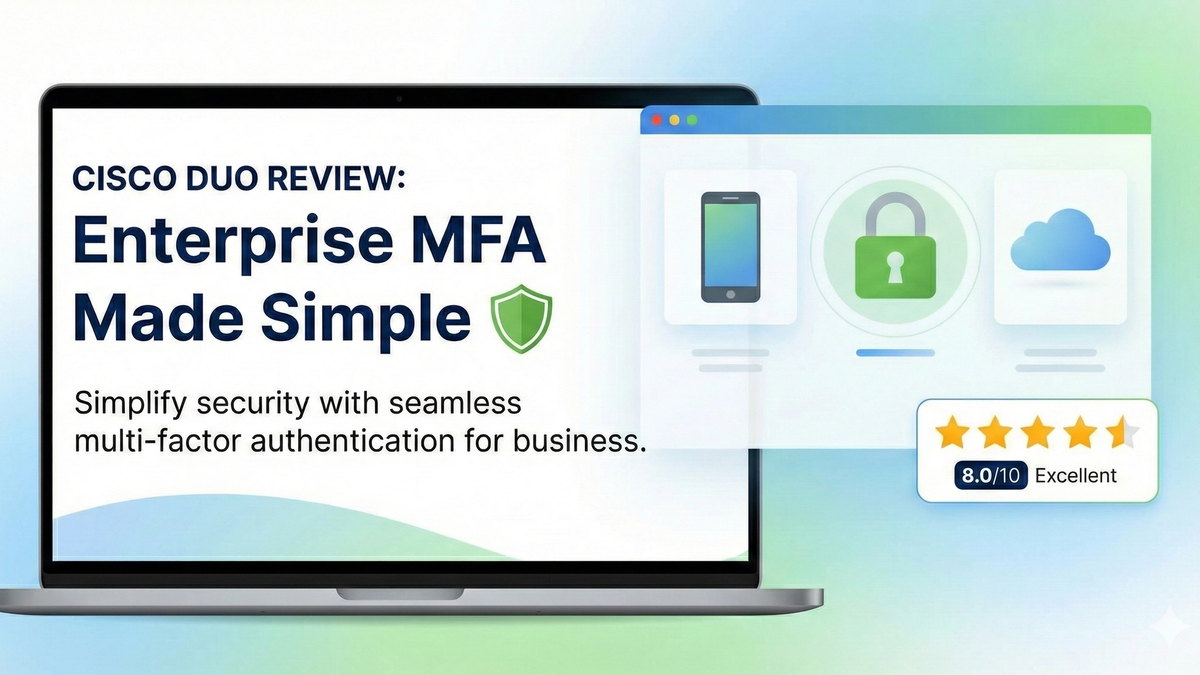
Cisco Duo Review: Enterprise MFA Made Simple
Cisco Duo delivers robust multi-factor authentication with one of the smoothest user experiences in the enterprise MFA space. While pricing can escalate quickly for larger teams, its device trust and adaptive policies make it a solid choice for security-conscious organizations.