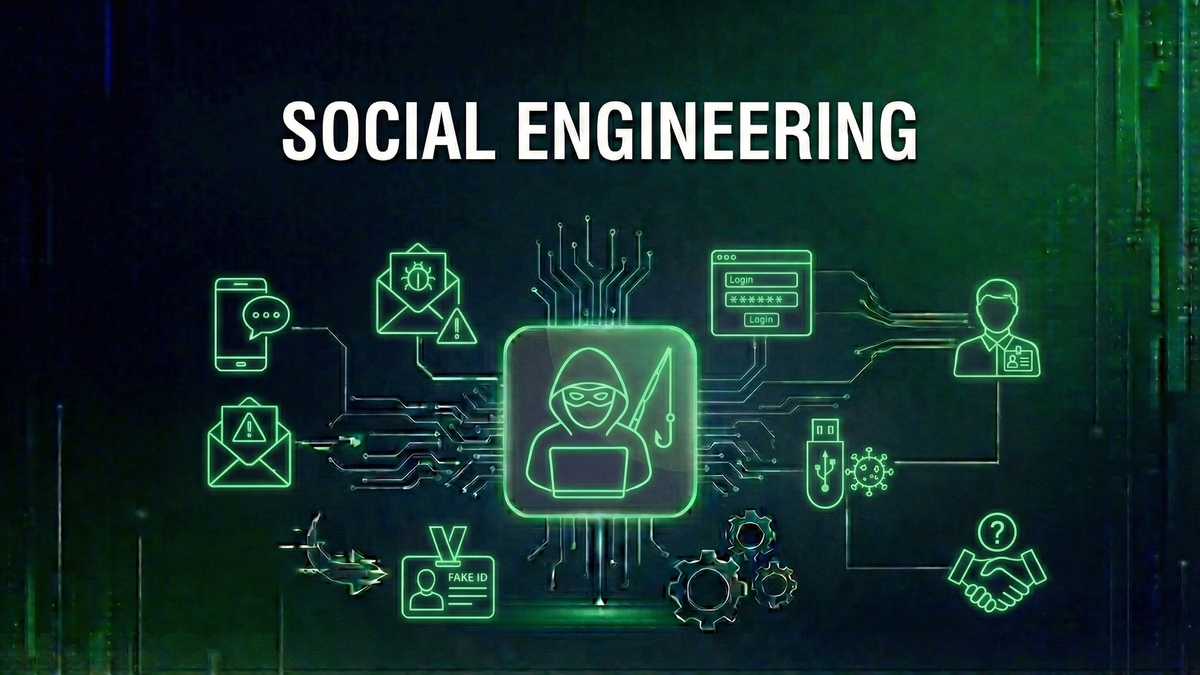
Social Engineering Attacks: The Complete Guide to Human-Targeted Threats
Social engineering exploits human psychology rather than technical flaws. Learn how attackers manipulate trust, urgency, and authority—and how to recognize and defend against these threats.
Your organization's most sophisticated security tools—firewalls, endpoint protection, encryptionEncryption🛡️The process of converting data into a coded format that can only be read with the correct decryption key.—can all be bypassed by a well-crafted email and a moment of misplaced trust. Social engineeringSocial Engineering🛡️The psychological manipulation of people into performing actions or divulging confidential information, exploiting human trust rather than technical vulnerabilities. remains the most effective attack vector in cybersecurity, responsible for over 90% of successful data breaches. Why? Because it targets the one vulnerabilityVulnerability🛡️A weakness in software, hardware, or processes that can be exploited by attackers to gain unauthorized access or cause harm. that can't be patched: human psychology.
Social engineering attacks manipulate people into breaking normal security procedures. Instead of finding technical exploits, attackers exploitExploit🛡️Code or technique that takes advantage of a vulnerability to cause unintended behavior, such as gaining unauthorized access. our natural tendencies—our desire to help, our respect for authority, our fear of missing out, and our trust in familiar brands and faces. These psychological triggers make social engineering devastatingly effective across all industries and experience levels.
The threat landscape has evolved dramatically. Modern attacks like ConsentFix (a 2025 consent phishingConsent PhishingPhishing🛡️A social engineering attack using fake emails or websites to steal login credentials or personal info.🛡️A social engineering attack where victims are tricked into granting malicious applications OAuthOAuth🛡️An open standard authorization protocol that allows applications to access user resources without exposing passwords, using tokens instead of credentials. permissions, giving attackers persistent access to their accounts. kit), callback phishingCallback Phishing🛡️A hybrid social engineering attack where phishing emails instruct victims to call a phone number, leading to vishingVishing🛡️Voice phishing—a social engineering attack conducted via phone calls where attackers impersonate trusted entities to extract sensitive information or payments. attacks that bypass email security controls. schemes, and AI-generated deepfake calls demonstrate how social engineering techniques continuously adapt to bypass new defenses. Understanding these attacks isn't optional—it's essential for anyone who uses email, answers phones, or works in an organization with valuable data.
In this guide, we'll explore what social engineering is, the major attack types you'll encounter, the psychological principles that make them work, and practical strategies to protect yourself and your organization. Whether you're an IT professional building a security awareness program or someone who simply wants to avoid becoming a victim, this knowledge is your first line of defense.
What is Social Engineering?
Social engineering is the art of manipulating people into giving up confidential information or taking actions that compromise security. Rather than hacking systems directly, social engineers "hack" human behavior—exploiting predictable patterns in how we think, feel, and respond to certain situations.
"Amateurs hack systems. Professionals hack people." — Bruce Schneier, Security Technologist
The term "social engineering" originated in the security community but the techniques are ancient. Con artists, spies, and fraudsters have exploited human nature for centuries. What's changed is the scale: digital communication allows attackers to target millions of people simultaneously at virtually no cost.
What Attackers Want
Social engineering attacks typically seek:
Types of Social Engineering Attacks
Social engineering attacks come in many forms, each exploiting different communication channels and psychological triggers. Understanding these categories helps you recognize threats regardless of the specific disguise.
Phishing
The most common social engineering attack. Phishing uses fraudulent emails, websites, or messages that impersonate trusted entities to steal credentials or deliver malware. Variations include:
Vishing (Voice Phishing)
Phone-based attacks where callers impersonate tech support, banks, government agencies, or colleagues. Vishing is particularly effective because voice communication creates a sense of urgency and legitimacy that's harder to verify than email. Caller ID spoofing makes calls appear to come from legitimate numbers.
SmishingSmishing🛡️SMS phishing—a social engineering attack using text messages to trick recipients into clicking malicious links or providing personal information. (SMS Phishing)
Text message attacks have surged because SMS lacks the spam filtering of email. Common smishing themes include fake delivery notifications ("Your package couldn't be delivered"), bank alerts, and tax refund scams. Links in texts often lead to credential harvesting sites.
PretextingPretexting🛡️A social engineering technique where attackers create a fabricated scenario (pretext) to manipulate victims into providing information or taking actions they normally would not.
Attackers create a fabricated scenario (the "pretext") to manipulate victims. Unlike basic phishing, pretexting involves building a storyline and often multiple interactions. Example: An attacker researches an employee on LinkedIn, then calls the IT help desk claiming to be that employee, locked out of their account while traveling.
BaitingBaiting🛡️A social engineering attack that uses a false promise or enticing offer to lure victims into a trap, such as leaving infected USB drives or offering free downloads.
Exploits human curiosity or greed with an enticing offer. Classic examples include:
Quid Pro Quo
Attackers offer something in exchange for information or access. A common scenario: calling random numbers at a company offering "IT support" until finding someone with a computer problem. The attacker "helps" by having the victim install remote access software.
TailgatingTailgating🛡️A physical social engineering technique where an unauthorized person follows an authorized individual into a restricted area, exploiting social courtesy. and Piggybacking
Physical social engineering where an unauthorized person follows an employee through a secured door. Attackers often carry boxes or coffee cups to appear like they belong, exploiting social courtesy ("I'll hold the door for you"). Piggybacking is similar but the employee is aware—often convinced the attacker is a vendor or new hire.
Modern Social Engineering Techniques
As defenses improve, attackers innovate. These contemporary techniques represent the cutting edge of social engineering in 2025.
Consent Phishing (OAuth Attacks)
Rather than stealing passwords, attackers trick victims into granting OAuth permissions to malicious applications. When you click "Allow" on that fake "Microsoft Security" app, you've given attackers persistent access to your email, files, and calendar—access that survives password changes and bypasses MFA entirely.
The December 2025 ConsentFix phishing kit commoditized this attack, enabling less sophisticated criminals to deploy consent phishing at scale. Learn more about this threat vector in our guide to OAuth Security.
Callback Phishing (Hybrid Attacks)
Also known as "TOAD" (Telephone-Oriented Attack Delivery), callback phishing sends emails that contain no malicious links or attachments—just a phone number and an urgent reason to call. Because there's nothing malicious in the email itself, these messages often bypass email security. Once the victim calls, trained operators guide them through installing remote access malware.
Common callback phishing themes include fake invoice disputes, subscription renewals for services you didn't sign up for, and "suspicious activity" alerts.
ClickFix Attacks
A technique that displays fake error messages instructing users to copy and paste malicious commands. Victims see what looks like a browser error with "troubleshooting steps" that actually execute PowerShell commands to download malware. Because the victim manually pastes the command, it bypasses many security controls.
Business Email Compromise (BEC)
Sophisticated attacks where criminals compromise or impersonate executive email accounts. After monitoring email patterns, they send payment requests to finance teams that appear to come from the CEO. BEC attacks caused over $2.7 billion in losses in 2023 alone. Common variations include invoice fraud (changing payment details on legitimate invoices) and real estate wire fraud (targeting home buyers).
AI-Powered Attacks and Deepfakes
Generative AI enables attackers to clone voices from short audio samples and create convincing video impersonations. Documented attacks have used deepfake audio of executives to authorize fraudulent wire transfers. AI also powers more convincing phishing emails—free of the grammatical errors that once made them easier to spot.
Why Social Engineering Works: The Psychology
Social engineering succeeds because it exploits hardwired human responses. Understanding these psychological principles helps you recognize when you're being manipulated.
Authority
We're conditioned to comply with authority figures. Attackers exploit this by impersonating IT departments, executives, law enforcement, or government agencies. "This is the IT security team—we need your password to update your account" works alarmingly often.
Urgency and Fear
Time pressure short-circuits critical thinking. Messages like "Your account will be suspended in 24 hours" or "Suspicious login detected—verify NOW" create panic that overrides caution. When we're afraid, we act first and think later.
Trust and Familiarity
We inherently trust familiar logos, email addresses that look right, and people who seem to know us. Attackers research targets to use correct names, reference real projects, and mimic legitimate communication styles. Seeing your company's logo makes your brain assume legitimacy.
Reciprocity
When someone does something for us, we feel obligated to return the favor. Quid pro quo attacks exploit this: the "IT support" person who "helps" you with your computer problem has created a social debt you'll repay by installing that "required update."
Curiosity
We can't resist opening things that promise hidden information. Subject lines like "Your recent performance review" or "Photo of you from the party" exploit this natural curiosity. USB drives labeled "Confidential" work for the same reason.
Social Proof
We follow the crowd. Messages that claim "Your colleagues have already completed this verification" or use familiar names create pressure to comply. If it seems like everyone else is doing it, it must be legitimate.
Real-World Examples and Case Studies
These high-profile incidents demonstrate how devastating social engineering can be—even to sophisticated organizations.
Twitter/X Hack (2020)
Attackers used phone-based social engineering to convince Twitter employees they were IT colleagues. They gained access to internal tools and hijacked high-profile accounts including Barack Obama, Joe Biden, Elon Musk, and Apple—posting cryptocurrency scams that netted over $100,000 in hours. The attack demonstrated how a single successful vishing call could compromise an entire platform.
Uber Breach (2022)
An 18-year-old hacker breached Uber using "MFA fatigue"—repeatedly triggering authentication requests until an employee accepted one to stop the notifications. The attacker then posed as IT support on WhatsApp, convincing the employee to accept the login. This granted access to Uber's internal systems, including source code and sensitive data.
MGM Resorts Attack (2023)
The Scattered Spider group caused $100 million in damages to MGM Resorts through a 10-minute phone call. Attackers found an employee on LinkedIn, called the IT help desk impersonating them, and convinced technicians to reset MFA. From there, they deployed ransomware that shut down slot machines, hotel keycards, and reservation systems for days.
Hong Kong Deepfake CFO (2024)
In one of the first major deepfake social engineering attacks, criminals used AI-generated video of a company's CFO and other executives in a video conference call. The finance employee, believing they were speaking with real executives, transferred $25 million to attacker-controlled accounts. Everyone on the call except the victim was an AI-generated fake.
How to Recognize Social Engineering Attempts
Developing a "security mindset" helps you spot manipulation attempts before falling victim. Watch for these warning signs:
Red Flags in Communications
Verification Strategies
Organizational Defenses Against Social Engineering
Protecting an organization requires a layered approach combining people, processes, and technology.
Security Awareness Training
The most effective defense is an educated workforce. Effective training programs include:
Policies and Procedures
Technical Controls
Conclusion
Social engineering remains the most effective attack vector because it targets the one system that can't be patched: human nature. Our built-in responses to authority, urgency, trust, and curiosity served us well for millennia—but now attackers weaponize these instincts against us.
The good news is that awareness dramatically reduces risk. Once you understand how social engineering works—the psychological triggers, the common techniques, the warning signs—you become much harder to manipulate. A healthy skepticism toward unexpected requests, combined with simple verification habits, defeats most attacks.
For organizations, building a security-aware culture is essential. This means more than annual compliance training—it requires ongoing education about current threats, easy reporting mechanisms, and an environment where questioning suspicious requests is encouraged rather than penalized.
Remember: Attackers only need one successful attempt. Defenders need to be right every time. Stay vigilant, verify before trusting, and when in doubt—report it.
Related Reading
For a deeper dive into consent phishing and OAuth-based attacks, read our guide on Understanding OAuth Security. To protect your Microsoft 365Microsoft 365🌐Microsoft's subscription-based cloud productivity suite including Office applications, Exchange Online, SharePoint, and Teams. environment against these threats, see our Microsoft 365 Security Best Practices guide. For the latest news on social engineering campaigns, check our coverage of the ConsentFix phishing kit and other emerging threats.
Keep Learning
Related Reviews

REOLINK 4K Security Camera System Review: Professional PoE Surveillance at DIY Prices
The REOLINK 4K PoE security system delivers 8MP clarity, smart person/vehicle detection, 24/7 recording with 4TB storage, and plug-and-play installation for comprehensive home surveillance.
Ring Outdoor Cam Pro Review: 4K Security Camera with Radar-Powered Motion Detection
The Ring Outdoor Cam Pro delivers Retinal 4K video, 10x enhanced zoom, Low-Light Sight for true color night vision, and radar-powered 3D motion detection for precise security alerts.
Cisco Duo Review: Enterprise MFA Made Simple
Cisco Duo delivers robust multi-factor authentication with one of the smoothest user experiences in the enterprise MFA space. While pricing can escalate quickly for larger teams, its device trust and adaptive policies make it a solid choice for security-conscious organizations.