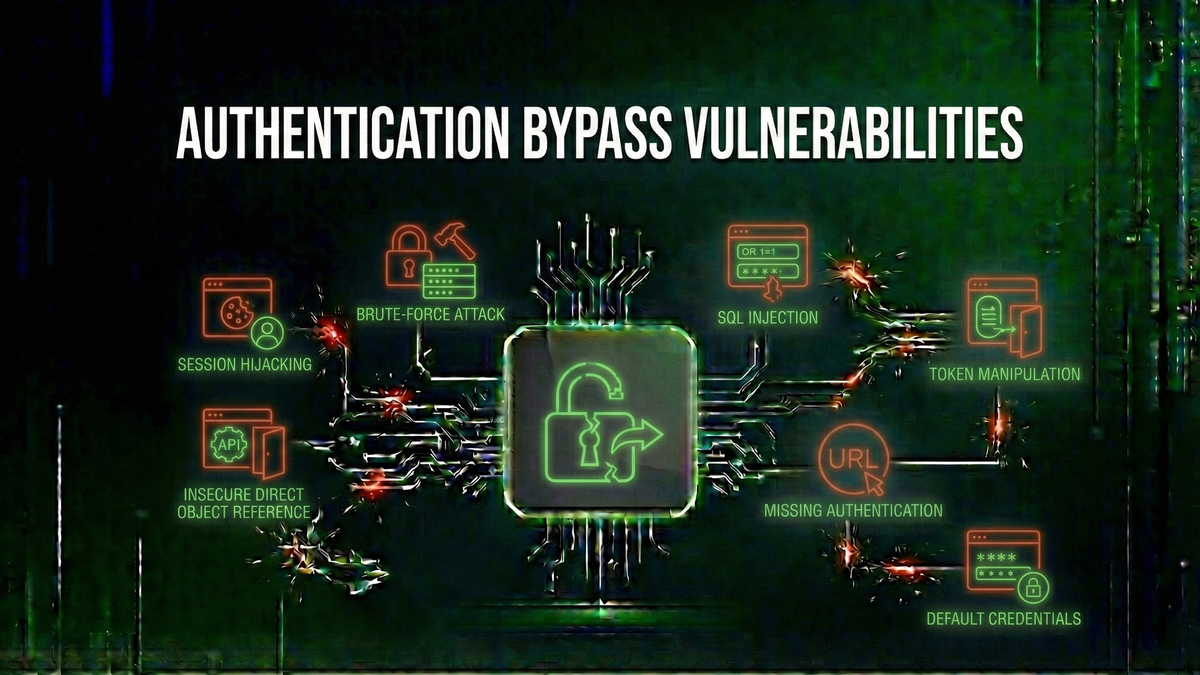
Authentication Bypass Vulnerabilities: How Attackers Defeat Login Security
A technical deep dive into authentication bypass vulnerabilities—from cryptographic signature flaws to logic errors.
Authentication bypassAuthentication Bypass📖A security vulnerabilityVulnerability🛡️A weakness in software, hardware, or processes that can be exploited by attackers to gain unauthorized access or cause harm. that allows an attacker to circumvent the login verification process and gain unauthorized access to a system without providing valid credentials. vulnerabilities represent some of the most critical security flaws that can affect a system. When attackers can circumvent login verification, they gain unauthorized access without knowing valid credentials—often with administrative privileges. The recent Fortinet CVE-2025-59718 and CVE-2025-59719 vulnerabilities, which allowed attackers to bypass FortiCloudFortiCloud📖Fortinet's cloud-based management and services platform that provides centralized management, logging, reporting, and single sign-on capabilities for Fortinet security products. SSO authentication through flawed cryptographic signatureCryptographic Signature📖A mathematical scheme that uses public key cryptography to verify the authenticity and integrity of digital data, ensuring the content has not been altered and was created by the claimed sender. validation, demonstrate the severe real-world impact of these vulnerabilities.
This advanced guide examines the technical mechanisms behind authentication bypass vulnerabilities, including cryptographic implementation flaws, logic errors, and protocol-level attacks. You will learn how these vulnerabilities occur, how attackers exploitExploit🛡️Code or technique that takes advantage of a vulnerability to cause unintended behavior, such as gaining unauthorized access. them, and how developers and security professionals can prevent them. Understanding these attack techniques is essential for both building secure systems and identifying vulnerabilities during security assessments.
Authentication Fundamentals
Before examining bypass techniques, it is important to understand what authentication is trying to accomplish. Authentication is the process of verifying that a user or system is who they claim to be. It answers the question: "Are you really who you say you are?"
Authentication systems generally rely on one or more factors: something you know (passwords, PINs), something you have (tokens, certificates, phones), or something you are (biometrics). Modern enterprise authentication often involves multiple systems working together—identity providers, authentication protocols like SAML or OAuthOAuth🛡️An open standard authorization protocol that allows applications to access user resources without exposing passwords, using tokens instead of credentials., and cryptographic verification of claims.
Authentication bypass occurs when attackers find ways to convince a system they are authenticated without actually completing the intended verification process. This can happen at multiple layers: the credential verification layer, the cryptographic validation layer, or the session management layer.
Categories of Authentication Bypass
Authentication bypass vulnerabilities fall into several distinct categories, each requiring different exploitation techniques and defensive measures.
Cryptographic Implementation Flaws
These vulnerabilities occur when cryptographic operations used in authentication are implemented incorrectly. The Fortinet SSO vulnerabilities are a prime example—the cryptographic signature verification of SAML assertions had implementation flaws that allowed attackers to forge authentication tokens.
Common cryptographic bypass issues include signature verification failures (not properly validating that signatures are present and mathematically correct), algorithm confusion attacks (exploiting differences in how algorithms are specified or verified), key management issues (accepting keys from untrusted sources or not properly validating key ownership), and timing attacks (exploiting timing differences in cryptographic operations to extract secrets).
Logic and Business Logic Flaws
Logic flaws occur when the authentication workflow has gaps that allow attackers to skip steps or manipulate the process. These include step-skipping (accessing protected resources by directly navigating to URLs without completing authentication), parameter manipulation (modifying hidden form fields, cookies, or API parameters to change authentication state), race conditions (exploiting timing windows where authentication state is inconsistent), and default credential issues (systems shipping with known default credentials that are not forced to change).
Injection-Based Bypass
Injection attacks manipulate the authentication query or process by inserting malicious content. SQL injection can modify authentication queries to return true regardless of credentials. LDAP injection can bypass authentication by manipulating directory service queries. XML/SAML injection can alter assertion content to grant unauthorized access. NoSQL injection can manipulate document-based authentication checks.
SAML Authentication Bypass: A Deep Dive
Given the relevance of SAML vulnerabilities to the Fortinet CVEs, let us examine SAML authentication bypass techniques in detail. SAML's complexity has made it a rich source of authentication bypass vulnerabilities over the years.
Signature Validation Bypass
The most severe SAML vulnerabilities involve bypassing or circumventing signature validation entirely. There are several ways this can occur:
XML Signature Wrapping (XSW) Attacks
XSW attacks exploit the disconnect between signature verification and assertion processing. In these attacks, the attacker takes a legitimately signed assertion and wraps it—moving the signed portion to a location where it is verified but not processed for authentication, while placing a malicious unsigned assertion where it will be used for access decisions.
Researchers have documented over 20 variants of XSW attacks. The defense requires ensuring that the exact element that was signed is the same element used for authentication decisions—a property that is surprisingly difficult to implement correctly in XML.
Comment Truncation Attacks
Some XML parsers handle comments differently during canonicalization (the process of normalizing XML for signature verification) versus assertion processing. By inserting strategically placed comments, attackers can cause the signature verification to see one value while the application processes another. For example, an assertion for "user@victim.com" might contain "user@attacker.com@victim.com" which verifies against a signature for "user" but processes as "user@attacker.com".
JWT Authentication Bypass Techniques
JSON Web Tokens (JWT) are increasingly used for authentication, particularly in modern web applications and APIs. While simpler than SAML, JWT implementations are also vulnerable to authentication bypass.
Algorithm "none" Attack
The JWT specification includes an "alg" header that specifies the signing algorithm. The specification allows "none" as a valid algorithm for unsigned tokens. Vulnerable implementations that do not explicitly reject the "none" algorithm will accept unsigned tokens as valid, allowing attackers to forge any JWT by simply removing the signature and setting the algorithm to "none".
Algorithm Confusion
Many JWT implementations support both symmetric (HMAC) and asymmetric (RSA/ECDSA) algorithms. In asymmetric cryptography, the server uses a private key to sign and a public key to verify. In symmetric cryptography, the same secret is used for both operations. If an attacker can trick a server configured for asymmetric verification into using symmetric verification with the public key as the secret, they can sign tokens themselves—because the public key is typically known.
Key Injection via JWK Header
Some JWT libraries support including the verification key directly in the token's header via the "jwk" parameter. Vulnerable implementations that trust this embedded key allow attackers to sign tokens with their own key and include that key in the token—the server then uses the attacker's key to verify the attacker's signature, accepting forged tokens as valid.
Preventing Authentication Bypass Vulnerabilities
Protecting systems from authentication bypass requires attention at multiple levels: secure implementation, proper configuration, and defense in depthDefense in Depth🛡️A security strategy using multiple layers of protection so that if one layer fails, other layers continue to provide security..
Use Well-Tested Libraries
Never implement authentication protocols or cryptographic operations from scratch. Use established, actively maintained libraries that have been reviewed for security issues. For SAML, use libraries like OneLogin's toolkit or OpenSAML. For JWT, use libraries that are on the jwt.io recommended list and have been audited. Keep these libraries updated—many authentication bypass vulnerabilities are fixed in updates.
Enforce Strict Validation
Configure authentication systems to reject anything that deviates from expected patterns. Require signatures on all SAML assertions—never make them optional. Explicitly whitelist allowed JWT algorithms and reject all others, especially "none". Validate that signed content matches processed content (prevent wrapping attacks). Check all conditions, timestamps, and audience restrictions.
Implement Multi-Factor Authentication
Even if primary authentication is bypassed, additional factors can prevent unauthorized access. Require MFA for administrative access and sensitive operations. Use hardware security keys or authenticator apps rather than SMS. Implement step-up authentication for high-risk actions.
Monitor for Anomalies
Authentication systems should log all authentication events and monitor for suspicious patterns. Alert on authentication from unexpected locations or devices, unusual timing patterns (such as successful auth followed immediately by sensitive actions), authentication tokens with unusual characteristics, and high volumes of authentication attempts.
Regular Security Testing
Authentication systems should be regularly tested for bypass vulnerabilities. Include authentication testing in penetration tests. Use automated scanners that check for common authentication flaws. Conduct code reviews focusing on authentication logic. Test configuration changes before deployment.
Real-World Authentication Bypass Cases
Understanding past authentication bypass incidents provides valuable lessons for preventing future vulnerabilities.
Fortinet FortiCloud SSO (CVE-2025-59718/59719)
These December 2025 vulnerabilities allowed attackers to bypass authentication on FortiOS, FortiProxy, FortiSwitchManager, and FortiWeb through flawed SAML signature validation. Attackers submitted maliciously crafted SAML assertions that the systems accepted as legitimate, granting administrative access without valid credentials. The vulnerabilities were actively exploitedActively Exploited🛡️A vulnerability that attackers are currently using in real-world attacks, requiring immediate patching regardless of severity score. to steal firewallFirewall🌐Security system that monitors and controls network traffic based on predetermined rules. configuration files.
SolarWinds SAML Token Forgery
The 2020 SolarWinds supply chain attackSupply Chain Attack📖A cyberattack that targets an organization by compromising a third-party vendor, supplier, or partner that has access to the target's systems or data. included a SAML token forgery technique where attackers used stolen signing certificates to forge SAML tokens, enabling them to access cloud services as any user without triggering multi-factor authentication. This demonstrated how authentication bypass can be achieved through compromised trust relationships.
Auth0 JWT Validation Bypass
Multiple JWT libraries, including those used by Auth0, were found vulnerable to algorithm confusion attacks. By changing the algorithm in the token header from RS256 (asymmetric) to HS256 (symmetric), attackers could sign tokens using the public key—which was intended only for verification—as the symmetric secret, achieving complete authentication bypass.
Key Takeaways
Authentication bypass vulnerabilities can have catastrophic consequences, granting attackers unauthorized access to protected systems. Protecting against these attacks requires understanding both the attack techniques and defensive best practices:
Keep Learning
Frequently Asked Questions
What authentication methods are most secure?
Multi-factor authentication (MFA) using hardware security keys or authenticator apps provides the strongest protection. Avoid SMS-based verification when possible, and use a password managerPassword Manager🛡️Software that securely stores and auto-fills passwords, generating strong unique passwords for each account. for unique, complex passwords.
How do I know if my systems are affected by these vulnerabilities?
Check vendor advisories for affected versions, use vulnerability scanners, review your asset inventory, and monitor CISA's Known Exploited Vulnerabilities catalog for active threats requiring immediate attention.
Who should read this Authentication Bypass Vulnerabilities guide?
This advanced-level guide is written for IT professionals, security analysts, and system administrators working in cybersecurity. Beginners will find foundational concepts, while experienced practitioners can use it as a reference.
What will I learn from this article?
A technical deep dive into authentication bypass vulnerabilities—from cryptographic signature flaws to logic errors.
Related Reviews

REOLINK 4K Security Camera System Review: Professional PoE Surveillance at DIY Prices
The REOLINK 4K PoE security system delivers 8MP clarity, smart person/vehicle detection, 24/7 recording with 4TB storage, and plug-and-play installation for comprehensive home surveillance.
Ring Outdoor Cam Pro Review: 4K Security Camera with Radar-Powered Motion Detection
The Ring Outdoor Cam Pro delivers Retinal 4K video, 10x enhanced zoom, Low-Light Sight for true color night vision, and radar-powered 3D motion detection for precise security alerts.
Cisco Duo Review: Enterprise MFA Made Simple
Cisco Duo delivers robust multi-factor authentication with one of the smoothest user experiences in the enterprise MFA space. While pricing can escalate quickly for larger teams, its device trust and adaptive policies make it a solid choice for security-conscious organizations.