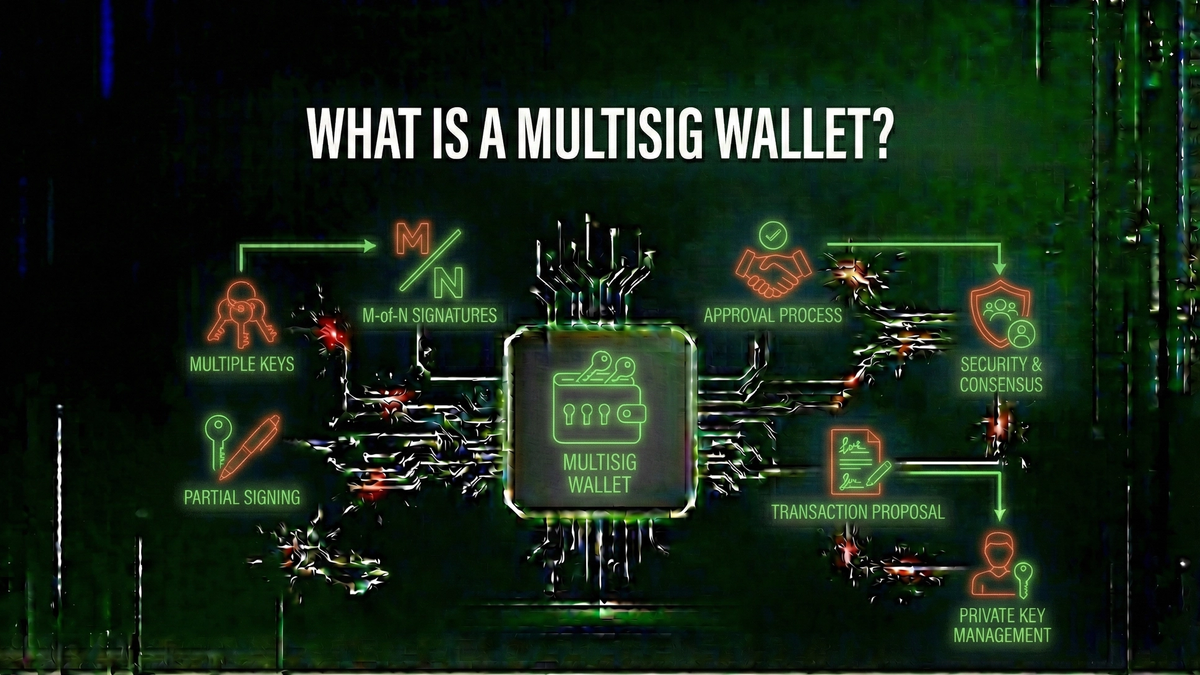
What is a Multisig Wallet? Understanding Multi-Signature Security
Learn how multisig wallets require multiple approvals for transactions, providing enhanced security for cryptocurrency holdings and organizational funds.
If you've ever wondered how cryptocurrency projects protect millions of dollars in digital assets, the answer often lies in a security mechanism called a multisig walletMultisig Wallet🛡️A cryptocurrency wallet that requires multiple private key signatures to authorize transactions, providing enhanced security by eliminating single points of failure.. Short for "multi-signature," these specialized wallets require approval from multiple parties before any transaction can be executed—similar to how a bank vault might require two keys held by different people to open.
In this guide, you'll learn how multisig wallets work, why they're essential for securing large cryptocurrency holdings, and how to evaluate whether a project's multisig setup provides adequate protection. Understanding this technology is crucial for anyone investing in DeFi protocols or managing significant crypto assets.
How Traditional Crypto Wallets Work
Before diving into multisig wallets, it's helpful to understand how standard cryptocurrency wallets function. A traditional crypto wallet is controlled by a single private key—a long string of characters that proves ownership and authorizes transactions. Whoever possesses this private key has complete control over all assets in the wallet. This single-key model works well for personal use but creates significant risks: single point of failure, no checks and balances, inheritance problems, and insider threat vulnerabilityVulnerability🛡️A weakness in software, hardware, or processes that can be exploited by attackers to gain unauthorized access or cause harm..
What Makes Multisig Different?
A multisig wallet requires multiple private keys to authorize a transaction, following an "M-of-N" signature scheme. For example, a "2-of-3" multisig requires any 2 signatures from a total of 3 authorized signers before a transaction can proceed. This design eliminates single points of failure, enforces oversight, provides redundancy, and creates audit trails.
Common Multisig Configurations
Different organizations choose different multisig configurations based on their security needs. 2-of-3 is popular for small teams, 3-of-5 for medium-sized DAOs, and 4-of-7 or 5-of-9 for larger protocols with maximum security requirements.
How Multisig Transactions Work
Understanding the transaction flow helps clarify why multisig provides such robust security. The process involves: 1) Transaction Proposal - one signer creates and signs a transaction, 2) Pending State - transaction waits for more signatures, 3) Additional Signatures - other signers review and approve, 4) Threshold Reached - required signatures collected, 5) Execution - funds are transferred.
Popular Multisig Solutions
Several platforms have emerged as industry standards: Gnosis Safe (Safe) for Ethereum securing over $100 billion in assets, Squads for Solana-based projects, and Bitcoin native multisig supported by hardware wallets like Ledger, Trezor, and Coldcard.
Security Vulnerabilities to Watch For
While multisig wallets significantly improve security, they're not invulnerable. Key vulnerabilities include: key compromise (if an attacker gets enough signing keys), poor signer diversity (all signers at same company), low signature thresholds (like 2-of-7), smart contract vulnerabilities, and implementation self-destruct attacks. The 2024 Unleash Protocol hack demonstrated the key compromise vulnerability.
Evaluating a Protocol's Multisig Security
When investing in or using a DeFi protocol, consider asking: What is the signature threshold? Who are the signers? Is there a timelock? What multisig platform is used? Is the multisig address public?
Key Takeaways
Multisig wallets require multiple signatures, eliminating single points of failure. The M-of-N configuration determines required signatures. Security depends on signer diversity, key security, and operational practices. Even well-designed multisigs can be compromised if attackers gain enough keys. Look for protocols using established solutions, timelocks, and transparent signer information.
Keep Learning
Related Reviews

REOLINK 4K Security Camera System Review: Professional PoE Surveillance at DIY Prices
The REOLINK 4K PoE security system delivers 8MP clarity, smart person/vehicle detection, 24/7 recording with 4TB storage, and plug-and-play installation for comprehensive home surveillance.
Ring Outdoor Cam Pro Review: 4K Security Camera with Radar-Powered Motion Detection
The Ring Outdoor Cam Pro delivers Retinal 4K video, 10x enhanced zoom, Low-Light Sight for true color night vision, and radar-powered 3D motion detection for precise security alerts.
Cisco Duo Review: Enterprise MFA Made Simple
Cisco Duo delivers robust multi-factor authentication with one of the smoothest user experiences in the enterprise MFA space. While pricing can escalate quickly for larger teams, its device trust and adaptive policies make it a solid choice for security-conscious organizations.