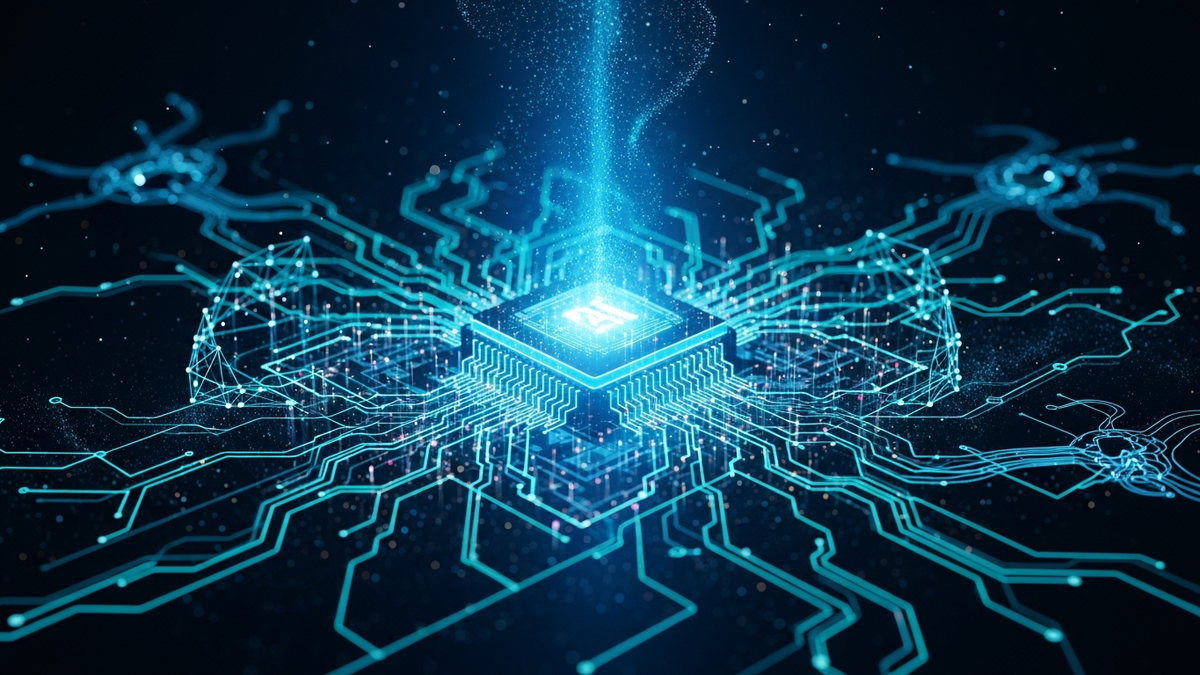
What Is Artificial Intelligence Hardware and Why Does It Matter
Artificial Intelligence has transformed from a concept confined to science fiction into a technology that powers our daily lives. From the voice assistant on your smartphone to the recommendation...
Introduction
Artificial Intelligence has transformed from a concept confined to science fiction into a technology that powers our daily lives. From the voice assistant on your smartphone to the recommendation algorithm on your favorite streaming service, AI is everywhere. But behind these seemingly magical capabilities lies a crucial foundation that often goes unnoticed: specialized hardware designed specifically for AI workloads.
Understanding AI hardware isn't just for engineers and data scientists anymore. As AI becomes increasingly integrated into business operations, consumer products, and critical infrastructure, knowing what makes these systems tick becomes essential for technology professionals, business leaders, and informed consumers alike.
This article will demystify AI hardware, explaining what it is, why it differs from traditional computing hardware, and why it matters for the future of technology. Whether you're considering an AI implementation for your business, curious about the technology behind your devices, or planning a career in tech, this comprehensive guide will provide the foundational knowledge you need.
The stakes are high. Companies are investing billions in AI hardware infrastructure, governments are racing to secure chip manufacturing capabilities, and the performance gap between AI-optimized and traditional hardware continues to widen. Understanding this landscape isn't just academically interesting—it's becoming a competitive necessity.
Core Concepts
What Makes AI Hardware Different
Traditional computer processors, or CPUs (Central Processing Units), excel at sequential processing—executing instructions one after another with incredible speed and flexibility. They're generalists, capable of handling everything from word processing to database management. However, AI workloads have fundamentally different computational requirements.
AI, particularly deep learning, involves massive parallel computations on large datasets. Training a modern language model might require performing trillions of mathematical operations, primarily matrix multiplications and additions, across billions of data points. This workload pattern is radically different from running a spreadsheet or rendering a document.
AI hardware is purpose-built to handle these specific computational patterns efficiently. Rather than processing instructions sequentially, AI accelerators perform thousands or millions of simple operations simultaneously. This architectural difference makes specialized AI hardware orders of magnitude more efficient for machine learning tasks.
Key Types of AI Hardware
**Graphics Processing Units (GPUs)**: Originally designed for rendering graphics, GPUs proved exceptionally well-suited for AI workloads due to their parallel processing architecture. A modern GPU contains thousands of smaller cores that can perform simultaneous calculations, making them ideal for the matrix operations that dominate machine learning.
**Tensor Processing Units (TPUs)**: Developed by Google specifically for neural network operations, TPUs represent purpose-built AI hardware. They're optimized for the tensor operations (multi-dimensional array computations) that form the backbone of deep learning, offering superior performance and energy efficiency compared to general-purpose processors for these specific tasks.
**Field-Programmable Gate Arrays (FPGAs)**: These configurable chips can be programmed to perform specific functions with hardware-level efficiency. While requiring more expertise to program, FPGAs offer flexibility and can be optimized for particular AI models, making them valuable in specialized applications.
**Application-Specific Integrated Circuits (ASICs)**: These chips are custom-designed for specific applications and represent the ultimate in specialization. Companies like Tesla have developed their own ASICs for autonomous driving, optimizing every transistor for their particular AI workload.
**Neural Processing Units (NPUs)**: Increasingly found in smartphones and edge devices, NPUs are compact AI accelerators designed to run inference (applying trained models) efficiently on devices with limited power budgets.
Training vs. Inference
Understanding AI hardware requires distinguishing between two primary phases of AI deployment:
**Training** is the process of creating an AI model by feeding it large amounts of data and adjusting its parameters until it learns to perform a task accurately. This phase is computationally intensive, often requiring days, weeks, or even months on powerful hardware clusters. Training typically happens in data centers with high-performance GPUs or TPUs.
**Inference** is applying a trained model to new data—like when you ask your voice assistant a question or when a security camera identifies a person. Inference is less computationally demanding than training but must often happen quickly and on resource-constrained devices. This has driven the development of specialized inference hardware for smartphones, IoT devices, and edge computing applications.
Different hardware excels at different phases. A data center might use NVIDIA A100 GPUs for training, while a smartphone uses a built-in NPU for running inference on device.
How It Works
Parallel Processing Architecture
The fundamental advantage of AI hardware lies in its parallel processing capabilities. Consider a simple example: multiplying two 1000x1000 matrices requires one billion multiply-and-add operations. On a CPU executing instructions sequentially, this takes considerable time. On a GPU with thousands of cores, these operations can happen simultaneously, reducing processing time from seconds to milliseconds.
Modern GPUs contain specialized units called Tensor Cores (in NVIDIA hardware) or Matrix Engines (in AMD hardware) that can perform entire matrix operations in single clock cycles. This architectural specialization accelerates the exact operations that neural networks depend on most heavily.
Memory BandwidthBandwidth🌐Maximum data transfer rate of a network connection, measured in Mbps or Gbps. and Data Movement
AI workloads are often limited not by processing power but by how quickly data can move between memory and processors. Neural networks require constant access to millions or billions of parameters (the learned weights of the model), and fetching this data can become a bottleneck.
AI hardware addresses this challenge through several innovations:
**High-Bandwidth Memory (HBM)**: Specialized memory that can transfer data to processors much faster than standard RAM, though at higher cost. Premium GPUs and AI accelerators use HBM to ensure processors aren't starved for data.
**On-Chip Memory**: Placing memory physically closer to processing units reduces latencyLatency🌐The delay between sending a request and receiving a response, measured in milliseconds (ping). and increases bandwidth. TPUs, for instance, include substantial on-chip memory to minimize data movement.
**Optimized Data Paths**: AI accelerators are designed with data flow in mind, ensuring that information moves efficiently between memory, processing units, and interconnects.
Precision and Quantization
Neural networks don't always require the high numerical precision that traditional computing demands. While scientific simulations might need 64-bit floating-point precision, many AI models work effectively with 32-bit, 16-bit, or even 8-bit precision.
AI hardware exploits this flexibility through reduced precision arithmetic. Processing 16-bit numbers requires less energy and chip area than 64-bit numbers, allowing more operations per second and better energy efficiency. Modern AI accelerators support mixed-precision training, using higher precision where necessary and lower precision where acceptable.
Quantization—converting trained models to use lower-precision numbers—can reduce model size by 4x or more while maintaining accuracy. This makes AI hardware even more efficient, particularly for inference on edge devices where power and storage are limited.
Interconnect and Scale
The largest AI models exceed the capacity of any single processor, requiring distributed computing across multiple chips or even multiple machines. This makes interconnect technology—how processors communicate—critical for AI hardware performance.
**NVLink and NVSwitch**: NVIDIA's proprietaryProprietary📖Software owned by a company with restricted access to source code. high-speed interconnects allow GPUs to communicate much faster than traditional PCIe connections, enabling efficient multi-GPU training.
**Infinity Fabric**: AMD's interconnect technology provides similar capabilities for linking multiple processors.
**Custom Interconnects**: Large-scale AI training systems like Google's TPU pods use custom networking to connect thousands of processors into a single coherent system.
The quality of these interconnects often determines whether adding more hardware actually improves performance or simply creates communication bottlenecks.
Real-World Examples
Autonomous Vehicles
Self-driving cars represent one of the most demanding real-world applications of AI hardware. A vehicle like a Tesla must process input from multiple cameras, radar, and ultrasonic sensors, running complex neural networks to detect objects, predict behavior, and plan routes—all in real-time with human lives depending on reliability.
Tesla developed its own AI chip, the FSD (Full Self-Driving) Computer, specifically for this purpose. Each chip contains two independent AI processors for redundancy, capable of 144 trillion operations per second. This specialized hardware runs entirely in the vehicle, processing sensor data with latency measured in milliseconds.
The alternative—general-purpose processors—would either be too slow for safe real-time operation or consume too much power for a battery-electric vehicle. This example illustrates why specialized AI hardware isn't just about performance; it's about making applications feasible at all.
Smartphone AI
Modern smartphones perform surprisingly sophisticated AI tasks: real-time language translation, computational photography, face authentication, and voice recognition. These applications must work instantly, even without internet connectivity, and without draining the battery.
Apple's Neural Engine, integrated into their A-series and M-series chips, exemplifies mobile AI hardware. Introduced in 2017, the Neural Engine performs up to 17 trillion operations per second in the latest iPhone models, enabling features like Live Text (extracting text from camera images in real-time) and photographic style adjustments that adapt to scene content.
Google's Tensor chips in Pixel phones similarly include dedicated AI accelerators, powering features like Magic Eraser (removing unwanted objects from photos) and Live Caption (real-time captioning of any audio on the device). These features would be impossible with software running on general-purpose CPU cores alone.
Cloud
Related Reviews

REOLINK 4K Security Camera System Review: Professional PoE Surveillance at DIY Prices
The REOLINK 4K PoE security system delivers 8MP clarity, smart person/vehicle detection, 24/7 recording with 4TB storage, and plug-and-play installation for comprehensive home surveillance.
Ring Outdoor Cam Pro Review: 4K Security Camera with Radar-Powered Motion Detection
The Ring Outdoor Cam Pro delivers Retinal 4K video, 10x enhanced zoom, Low-Light Sight for true color night vision, and radar-powered 3D motion detection for precise security alerts.

Cisco Duo Review: Enterprise MFA Made Simple
Cisco Duo delivers robust multi-factor authentication with one of the smoothest user experiences in the enterprise MFA space. While pricing can escalate quickly for larger teams, its device trust and adaptive policies make it a solid choice for security-conscious organizations.