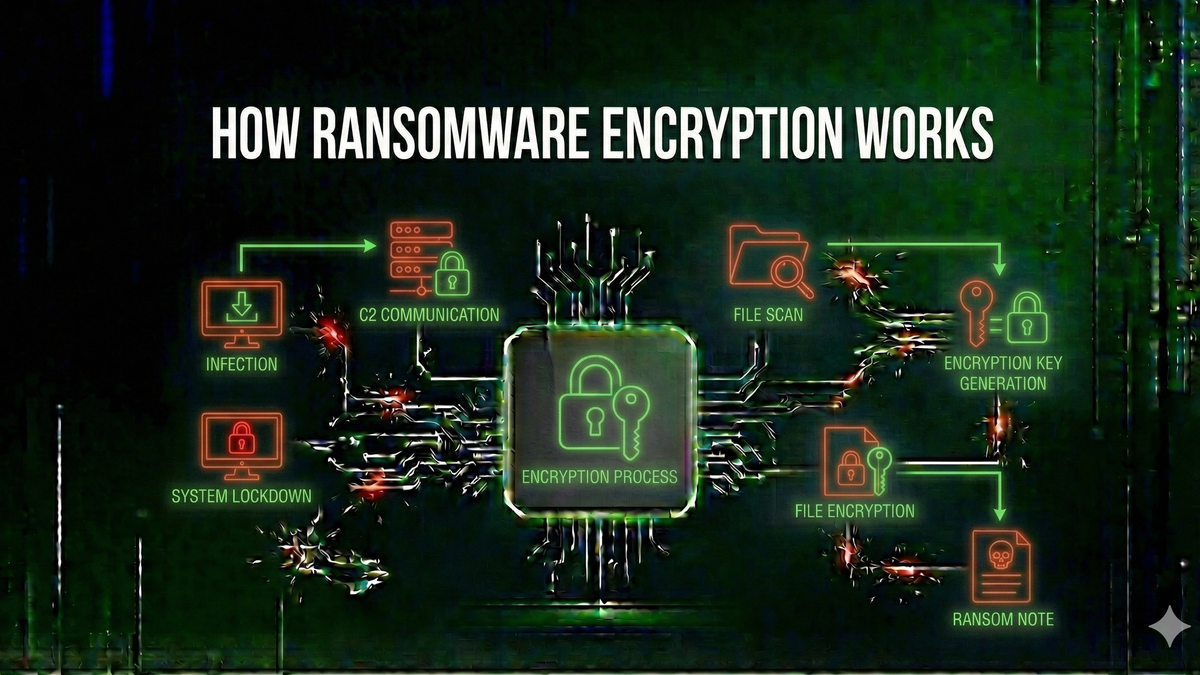
How Ransomware Encryption Works: From File Targeting to Key Management
A technical deep-dive into ransomware encryption mechanisms including symmetric and asymmetric cryptography, file targeting strategies, and why modern ransomware is so difficult to decrypt.
Ransomware attacks have devastated organizations worldwide, from hospitals forced to turn away patients to cities whose essential services ground to a halt. At the core of every ransomware attack lies encryptionEncryption🛡️The process of converting data into a coded format that can only be read with the correct decryption key.—the mathematical process that transforms accessible data into unintelligible ciphertext. Understanding how ransomware encryption works is essential for security professionals who must defend against these threats, respond to incidents, and evaluate recovery options.
This guide examines the technical mechanisms behind ransomware encryption, from the cryptographic algorithms used to the strategies employed for maximum impact. We will explore why properly implemented ransomware encryption is virtually impossible to break without the decryption key, and how recent innovations like the RansomHouse 'Mario' encryptor represent continued evolution in this threat landscape.
Cryptographic Foundations
Before diving into ransomware-specific implementations, it is important to understand the two fundamental types of encryption that form the basis of all modern ransomware: symmetric and asymmetric cryptography.
Symmetric Encryption
Symmetric encryption uses a single key for both encryption and decryption. The same key that locks the data also unlocks it. The Advanced Encryption Standard (AES) is the most common symmetric algorithm used in ransomware, particularly AES-256, which uses a 256-bit key length. AES operates on fixed-size blocks of data (128 bits) and is considered computationally secure—there is no known practical attack that can break properly implemented AES-256 encryption.
Symmetric encryption is fast, making it suitable for encrypting large volumes of data quickly. However, it presents a key distribution problem: if the same key encrypts and decrypts data, how do you securely share that key? This is where asymmetric cryptography comes into play.
Asymmetric Encryption
Asymmetric encryption uses a mathematically linked pair of keys: a public key and a private key. Data encrypted with the public key can only be decrypted with the corresponding private key, and vice versa. RSA (Rivest-Shamir-Adleman) is the most common asymmetric algorithm in ransomware, though Elliptic Curve Cryptography (ECC) is increasingly used due to its smaller key sizes and comparable security.
Asymmetric encryption solves the key distribution problem but is computationally expensive—too slow for encrypting large amounts of data. Modern ransomware combines both approaches in a hybrid scheme that leverages the strengths of each.
The Hybrid Encryption Scheme
Nearly all sophisticated ransomware uses a hybrid encryption approach that combines symmetric and asymmetric cryptography. This design maximizes encryption speed while ensuring that only the attacker can decrypt files. The process involves master key pair generation, session key generation, file encryption with the session key, session key protection via RSA encryption, and key destruction.
This hybrid approach means that even if security researchers capture the ransomware sample and extract the embedded RSA public key, they cannot decrypt files. Only the RSA private key—held by the attackers—can decrypt the session key needed to recover files.
File Targeting Strategies
Ransomware must carefully select which files to encrypt. Encrypting everything—including operating system files—would crash the system before the victim could see the ransom note. Modern ransomware implements sophisticated file targeting to maximize damage while keeping systems operational enough for victims to pay.
Extension-Based Targeting
Most ransomware maintains lists of target file extensions—document formats (.docx, .xlsx, .pdf), database files (.sql, .mdb), archives (.zip, .rar), images (.jpg, .png), and other valuable data types. Conversely, exclusion lists prevent encryption of system files (.exe, .dll, .sys) and operating system directories that would render the machine unusable.
Virtual Machine Targeting
Enterprise-focused ransomware like RansomHouse specifically targets virtualization platforms. VMware ESXi hosts store virtual machines as large files (.vmdk for virtual disks, .vmx for configuration). Encrypting these files at the hypervisorHypervisor🌐Software that creates and manages virtual machines by allocating physical hardware resources among multiple guest operating systems. VMware ESXi is a Type 1 (bare-metal) hypervisor. level can incapacitate entire data centers. This targeting strategy explains RansomHouse's development of the MrAgent tool and their Mario encryptor's VM-specific optimizations.
Encryption Modes and Techniques
The specific manner in which encryption is applied significantly affects both the attack's speed and the difficulty of recovery. Different ransomware families employ various techniques, each with trade-offs between encryption thoroughness and operational efficiency.
Intermittent EncryptionIntermittent Encryption🛡️A ransomware technique that encrypts files in chunks with gaps between encrypted regions, dramatically increasing encryption speed while still rendering files unusable.
The latest evolution in ransomware encryption, intermittent encryption encrypts files in chunks with gaps between encrypted regions. For example, ransomware might encrypt every 16KB while skipping the next 48KB. This approach offers several advantages: encryption proceeds much faster, file corruption is thorough enough to prevent use, and the non-linear pattern makes analysis more difficult.
The RansomHouse Mario encryptor exemplifies this approach with its dynamic chunk sizing and 8GB threshold. Files smaller than 8GB receive one treatment, while larger files are processed differently. The exact chunk sizes and intervals are calculated using complex mathematical formulas, making each file's encryption pattern unique and harder to predict or reverse.
Advanced Key Management
Sophisticated ransomware implements layered key management schemes that provide additional security against key recovery attempts. The Mario encryptor's dual-key system exemplifies this evolution.
Multi-Key Hierarchies
Some ransomware uses multiple layers of keys. A master key encrypts intermediate keys, which in turn encrypt file-specific keys. This hierarchy means that even if one key is somehow recovered, it only provides access to a portion of the encrypted data. The RansomHouse Mario variant uses a 32-byte primary key and an 8-byte secondary key in a two-stage transformation that increases encryption entropy.
Why Decryption Without Keys Is Usually Impossible
When properly implemented, modern ransomware encryption cannot be broken through technical means. AES-256 has a key space of 2^256 possible keys—a number so large it exceeds the number of atoms in the observable universe. Even with all computing power on Earth working together, brute-forcing a 256-bit key would take longer than the age of the universe. The only hope for decryption without paying comes from implementation flaws in the ransomware itself, but modern RaaS operations employ skilled developers who avoid these errors.
Key Takeaways
Understanding ransomware encryption helps set realistic expectations for incident response and emphasizes the critical importance of preventive security measures and robust backup strategies.
Keep Learning
Frequently Asked Questions
How can I protect my organization from ransomware attacks?
Protection requires a multi-layered approach including regular backups, security awareness training, endpoint protection, network segmentation, and keeping systems patched. This guide covers specific defensive measures in detail.
Who should read this How Ransomware Encryption Works guide?
This intermediate-level guide is written for IT professionals, security analysts, and system administrators working in cybersecurity. Beginners will find foundational concepts, while experienced practitioners can use it as a reference.
What will I learn from this article?
A technical deep-dive into ransomware encryption mechanisms including symmetric and asymmetric cryptography, file targeting strategies, and why modern ransomware is so difficult to decrypt.
Where can I learn more about cybersecurity?
Check the Related Content section below for additional articles on this topic. Our Learn hub and Glossary provide in-depth explanations of key terms and concepts.
Related Reviews

REOLINK 4K Security Camera System Review: Professional PoE Surveillance at DIY Prices
The REOLINK 4K PoE security system delivers 8MP clarity, smart person/vehicle detection, 24/7 recording with 4TB storage, and plug-and-play installation for comprehensive home surveillance.
Ring Outdoor Cam Pro Review: 4K Security Camera with Radar-Powered Motion Detection
The Ring Outdoor Cam Pro delivers Retinal 4K video, 10x enhanced zoom, Low-Light Sight for true color night vision, and radar-powered 3D motion detection for precise security alerts.
Cisco Duo Review: Enterprise MFA Made Simple
Cisco Duo delivers robust multi-factor authentication with one of the smoothest user experiences in the enterprise MFA space. While pricing can escalate quickly for larger teams, its device trust and adaptive policies make it a solid choice for security-conscious organizations.