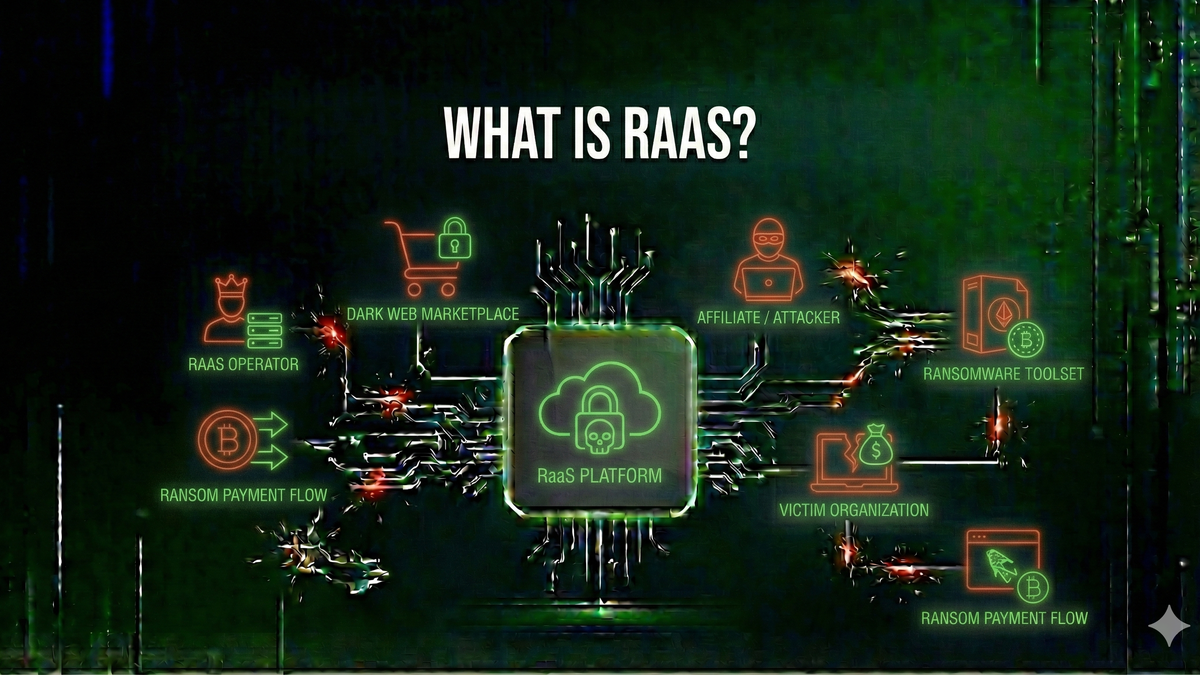
What Is Ransomware-as-a-Service (RaaS)? Understanding the Cybercrime Business Model
Learn how ransomware-as-a-service operations work, from affiliate recruitment to profit sharing. Understand the criminal ecosystem enabling modern ransomware attacks.
Ransomware has evolved from crude programs written by individual hackers into sophisticated criminal enterprises generating billions of dollars annually. At the heart of this transformation lies a business model called Ransomware-as-a-Service (RaaS). This model has democratized cybercrime, enabling individuals with limited technical skills to launch devastating attacks against organizations worldwide.
Understanding how RaaS operations function is essential for security professionals, business leaders, and anyone concerned about protecting their organization from modern cyber threats. This guide will walk you through the complete RaaS ecosystem, from the developers who create the malware to the affiliates who deploy it, and explain how these criminal enterprises operate with surprising professionalism.
What Is Ransomware-as-a-Service?
Ransomware-as-a-Service (RaaS) is a cybercrime business model in which ransomware developers create and maintain malicious software, then license it to other criminals (called affiliates) who carry out the actual attacks. This model mirrors legitimate software-as-a-service (SaaS) offerings, complete with subscription tiers, customer support, and revenue sharing arrangements.
In a traditional ransomware scenario, a single threat actor would need expertise in malware development, cryptography, infrastructure management, victim communication, and payment processing. RaaS separates these concerns, allowing specialists to focus on their strengths while sharing in the profits of successful attacks.
The RaaS model has proven remarkably effective. Groups like LockBit, BlackCat (ALPHV), Conti, and RansomHouse have built sophisticated operations that rival legitimate technology companies in terms of organization and operational efficiency. This professionalization of cybercrime represents one of the most significant evolutions in the threat landscape over the past decade.
How the RaaS Business Model Works
RaaS operations typically function through a structured hierarchy with clearly defined roles and revenue-sharing arrangements. Understanding this structure helps defenders anticipate attack patterns and develop more effective countermeasures.
Developers and Operators
At the top of the RaaS hierarchy sit the developers and operators. These individuals or teams possess advanced technical skills and are responsible for creating the ransomware payload, maintaining the encryptionEncryption🛡️The process of converting data into a coded format that can only be read with the correct decryption key. mechanisms, and building the infrastructure that supports the operation. Their responsibilities include malware development, infrastructure management, affiliate support, and often negotiation handling.
Affiliates
Affiliates are the individuals or groups who actually conduct attacks using the RaaS platform. They do not need to develop their own ransomware—instead, they focus on gaining access to victim networks and deploying the provided tools. Affiliate responsibilities typically include initial access, lateral movementLateral Movement🛡️Techniques attackers use to move through a network after initial compromise, seeking additional systems to control and data to steal., data exfiltrationData Exfiltration🛡️The unauthorized transfer of data from a computer or network, often performed by attackers before deploying ransomware to enable double extortion., and ransomware deployment.
Revenue Sharing Models
RaaS operations use various revenue-sharing arrangements. The most common model splits ransom payments between developers and affiliates, with affiliates typically receiving 60-80% of the proceeds. Some operations charge flat subscription fees, while others take a percentage of every successful ransom. High-performing affiliates may negotiate better terms over time.
The financial incentives are substantial. Major RaaS operations have generated hundreds of millions of dollars in ransom payments. This revenue funds continued development, attracts talented criminals, and enables investment in more sophisticated attack capabilities.
The Supporting Ecosystem
RaaS operations do not exist in isolation. They are part of a broader cybercrime ecosystem with numerous specialized roles and services that support ransomware attacks at every stage.
Initial Access Brokers (IABs)
Initial Access Brokers specialize in compromising organizations and selling that access to other criminals. Rather than conducting full attacks themselves, IABs focus on the initial intrusion phase, then auction off their access on dark web marketplaces. RaaS affiliates frequently purchase access from IABs rather than conducting their own initial compromise.
Access prices vary widely based on the target organization's size, industry, and perceived value. A foothold in a Fortune 500 company might sell for tens of thousands of dollars, while access to smaller organizations goes for a few hundred. This marketplace enables efficient specialization within the criminal ecosystem.
Bulletproof Hosting and Infrastructure
RaaS operations require resilient infrastructure that can withstand law enforcement takedown attempts and abuse complaints. Bulletproof hosting providers offer services specifically designed to protect criminal operations, operating in jurisdictions with weak cybercrime enforcement or using technical measures to maintain anonymity.
Cryptocurrency and Money Laundering
Ransomware payments almost universally occur in cryptocurrency, typically Bitcoin or Monero. However, converting these payments to usable currency requires specialized laundering services. Mixing services, decentralized exchanges, and over-the-counter trading desks help criminals obscure the origin of funds and convert cryptocurrency to fiat currency.
Notable RaaS Operations
Several RaaS operations have achieved particular notoriety due to their attack volume, technical sophistication, or high-profile victims. Understanding these groups provides insight into how the RaaS model operates in practice.
LockBit
LockBit emerged in 2019 and became one of the most prolific RaaS operations by 2022-2023. The group operates a highly organized affiliate program with strict operational security requirements. LockBit has consistently evolved its encryptor, releasing versions 2.0 and 3.0 with improved speed and evasion capabilities. The operation was significantly disrupted by law enforcement action in February 2024, though it has attempted to reconstitute itself afterward.
BlackCat (ALPHV)
BlackCat, also known as ALPHV, made headlines for being the first professional ransomware written in Rust, a modern programming language. This choice provided performance benefits and made analysis more difficult for security researchers. BlackCat operated a sophisticated affiliate program and was known for targeting critical infrastructure, including healthcare organizations.
RansomHouse
RansomHouse represents an interesting case study in RaaS evolution. Launched in December 2021 as a pure data extortion operation, the group initially did not encrypt victim files—instead, they stole data and threatened to publish it. Over time, RansomHouse adopted encryption capabilities, developing tools like their Mario encryptor and MrAgent for targeting VMware ESXi environments. This evolution demonstrates how RaaS operations adapt their tactics based on market conditions and victim responses.
Double and Triple Extortion Tactics
Modern RaaS operations have moved beyond simple encryption to employ multi-layered extortion strategies that increase pressure on victims to pay.
Double Extortion
Double extortion combines traditional file encryption with data theft. Before deploying ransomware, affiliates exfiltrate sensitive data from the victim network. Even if the victim can restore from backups, they face the threat of having their stolen data published on leak sites. This significantly increases the likelihood of payment, as organizations must weigh the regulatory, reputational, and legal consequences of data exposure.
Triple Extortion
Triple extortion adds a third pressure point, typically involving DDoS attacks against the victim or direct contact with the victim's customers, partners, or patients whose data was stolen. By creating additional disruption or embarrassment, attackers increase their leverage. Some groups have even contacted journalists or regulators to amplify pressure on victims.
Defending Against RaaS Attacks
While the RaaS model has made ransomware attacks more common and sophisticated, organizations can implement effective defenses. A layered security approach addresses the attack chain at multiple points.
Preventing Initial Access
Most ransomware attacks begin with phishingPhishing🛡️A social engineering attack using fake emails or websites to steal login credentials or personal info., exploited vulnerabilities, or compromised remote access. Organizations should implement robust email security, maintain aggressive patching programs, and secure remote access with multi-factor authentication. Reducing the attack surface limits opportunities for both affiliates and initial access brokers.
Detection and Response
Ransomware attacks typically involve significant activity before encryption begins—lateral movement, privilege escalationPrivilege Escalation🛡️An attack technique where an adversary gains elevated access rights beyond what was initially granted., and data exfiltration. Effective security monitoring can detect these precursor activities and enable response before ransomware deployment. Endpoint detection and response (EDR) solutions, network monitoring, and security information and event management (SIEM) systems all play important roles.
Backup and Recovery
When prevention and detection fail, recovery capability becomes critical. Organizations must maintain comprehensive, tested backup strategies with offline or immutable copies that ransomware cannot reach. The 3-2-1 backup rule—three copies on two different media types with one off-site—provides a starting point, though modern threats often require additional protections like air-gapped or immutable storage.
Key Takeaways
Ransomware-as-a-Service has transformed cybercrime into a professionalized industry with specialized roles, sophisticated tools, and substantial revenues. Understanding this model helps security professionals anticipate attack patterns and prioritize defensive measures appropriately.
Keep Learning
Related Reviews

REOLINK 4K Security Camera System Review: Professional PoE Surveillance at DIY Prices
The REOLINK 4K PoE security system delivers 8MP clarity, smart person/vehicle detection, 24/7 recording with 4TB storage, and plug-and-play installation for comprehensive home surveillance.
Ring Outdoor Cam Pro Review: 4K Security Camera with Radar-Powered Motion Detection
The Ring Outdoor Cam Pro delivers Retinal 4K video, 10x enhanced zoom, Low-Light Sight for true color night vision, and radar-powered 3D motion detection for precise security alerts.
Cisco Duo Review: Enterprise MFA Made Simple
Cisco Duo delivers robust multi-factor authentication with one of the smoothest user experiences in the enterprise MFA space. While pricing can escalate quickly for larger teams, its device trust and adaptive policies make it a solid choice for security-conscious organizations.