How Security Information Aggregation Platforms Protect Organizations
In today's digital landscape, organizations face an overwhelming torrent of security events, alerts, and data from countless sources. A medium-sized enterprise might deploy dozens of security too...
Introduction
In today's digital landscape, organizations face an overwhelming torrent of security events, alerts, and data from countless sources. A medium-sized enterprise might deploy dozens of security tools—firewalls, intrusion detection systems, endpoint protection platforms, cloud security monitors, and more—each generating its own stream of alerts and logs. Without a centralized way to collect, correlate, and analyze this information, security teams quickly become buried under data, missing critical threats while chasing false positives.
This is where Security Information Aggregation Platforms come into play. These systems act as a central nervous system for organizational security, collecting data from disparate sources, normalizing it into a common format, and providing security teams with a unified view of their security posture. By bringing order to chaos, these platforms enable faster threat detection, more effective incident response, and better overall security outcomes.
Understanding how these platforms work isn't just academic knowledge—it's essential for anyone involved in organizational security. Whether you're a security analyst, IT manager, or business leader responsible for protecting your organization's assets, this comprehensive guide will help you understand how security information aggregation platforms function, why they're critical to modern security operations, and how to implement them effectively.
In this article, we'll explore the fundamental concepts behind these systems, examine their operational mechanics, review real-world implementation examples, and provide actionable best practices for getting the most value from security information aggregation. By the end, you'll have a practical understanding of how these platforms can transform your organization's security capabilities.
Core Concepts
What Is Security Information Aggregation?
Security information aggregation is the process of collecting, consolidating, and normalizing security data from multiple sources into a centralized repository. Think of it as creating a single pane of glass through which security teams can view all security-relevant events occurring across an organization's entire digital infrastructure.
The core components of security information aggregation include:
**Data Collection**: The platform must ingest data from numerous sources—network devices, servers, applications, cloud services, identity systems, and specialized security tools. This requires supporting multiple protocols and data formats.
**Normalization**: Different systems report events in different formats. A firewallFirewall🌐Security system that monitors and controls network traffic based on predetermined rules. might log a blocked connection one way, while a web application firewall describes a similar event differently. Normalization converts all these diverse formats into a standardized schema that enables comparison and correlation.
**Enrichment**: Raw security events often lack context. Enrichment adds valuable information—such as threat intelligence, asset criticality, user information, or geolocation data—that helps analysts understand the significance of events.
**Correlation**: Perhaps the most powerful capability, correlation identifies patterns and relationships across seemingly unrelated events. A failed login attempt by itself might be unremarkable, but fifty failed attempts followed by a successful login from an unusual location tells a very different story.
The Evolution from Log Management to Security Analytics
Security information aggregation has evolved significantly over the past two decades. Early systems were essentially log management platforms—they collected and stored logs for compliance purposes but offered limited analytical capabilities.
The introduction of Security Information and Event Management (SIEM) systems represented a major leap forward. SIEMs combined log management with real-time event correlation and alerting, enabling proactive threat detection rather than just forensic analysis after incidents occurred.
Today's platforms have evolved even further, incorporating:
Key Benefits for Organizations
Security information aggregation platforms deliver several critical benefits:
**Improved Threat Detection**: By correlating events across multiple systems, these platforms can identify sophisticated attacks that individual security tools would miss. A credential compromise might not trigger any single system, but the aggregation platform can connect the dots between unusual access patterns, policy violations, and data exfiltrationData Exfiltration🛡️The unauthorized transfer of data from a computer or network, often performed by attackers before deploying ransomware to enable double extortion. attempts.
**Faster Incident Response**: When a security incident occurs, every minute counts. Having all relevant information aggregated in one place dramatically reduces the time analysts need to gather data, understand what happened, and take corrective action.
**Reduced Alert Fatigue**: Individual security tools often generate excessive false positives. Aggregation platforms can apply intelligence and context to filter noise and prioritize alerts based on actual risk, allowing analysts to focus on genuine threats.
**Compliance and Reporting**: Many regulatory frameworks require organizations to maintain security logs and demonstrate their security posture. Aggregation platforms simplify compliance by centralizing log retention and providing pre-built reports for common frameworks like PCI DSS, HIPAA, and GDPR.
**Visibility Across Hybrid Environments**: Modern organizations operate across on-premises data centers, multiple clouds, SaaS applications, and remote endpoints. Aggregation platforms provide unified visibility regardless of where systems and data reside.
How It Works
Data Collection Architecture
The foundation of any security information aggregation platform is its ability to collect data from diverse sources. This typically involves several collection mechanisms:
**Agent-Based Collection**: Software agents installed on endpoints, servers, and network devices actively monitor and forward security events to the central platform. Agents can often perform local processing to reduce the volume of data transmitted and provide deeper visibility into system activity.
**Agentless Collection**: For systems where installing agents isn't practical or possible, agentless collection uses standard protocols like Syslog, SNMP, or API connections. The platform pulls logs from sources at regular intervals or sources push logs to the platform.
**Network Sensors**: Specialized sensors deployed on network segments capture and analyze network traffic, providing visibility into lateral movementLateral Movement🛡️Techniques attackers use to move through a network after initial compromise, seeking additional systems to control and data to steal., command-and-control communications, and data exfiltration attempts.
**Cloud Connectors**: Purpose-built integrations with cloud platforms (AWS, Azure, GCP) and SaaS applications collect security events, configuration changes, and user activities from cloud environments.
The collection architecture must be designed for scalability and resilience. Large organizations might generate terabytes of security data daily, requiring distributed collection infrastructure with buffering capabilities to handle peak loads without losing data.
Data Processing Pipeline
Once collected, security data flows through a multi-stage processing pipeline:
**Parsing and Normalization**: Raw logs arrive in countless formats—some structured (like JSON), others unstructured text. Parsers extract relevant fields and map them to a common schema. For example, various sources might use different field names for the same concept (source_ip, src_address, origin_ip), but normalization ensures they're all mapped to a standard field name.
**Filtering and Aggregation**: Not all collected data needs to be retained indefinitely. The platform filters out purely informational events that have no security relevance and aggregates repetitive events (like thousands of identical failed authentication attempts) into summary records.
**Enrichment**: The platform augments events with additional context. An IP addressIP Address🔐A unique numerical identifier assigned to every device connected to the internet. might be enriched with geolocation data, threat intelligence reputation scores, and information about the asset at that address. A username might be enriched with the user's department, risk score, and normal behavior patterns.
**Indexing and Storage**: Processed events are indexed for fast searching and stored in optimized data stores. Modern platforms often use tiered storage, keeping recent data in fast SSD-based storage for active investigations while moving older data to cheaper long-term storage.
Correlation and Detection
The true power of security information aggregation emerges in the correlation and detection capabilities:
**Rule-Based Correlation**: Security analysts define correlation rules that describe attack patterns. For example: "Alert if a user has five failed login attempts within ten minutes followed by a successful login from a different country." The platform continuously evaluates rules against incoming events and generates alerts when conditions are met.
**Statistical Anomaly Detection**: The platform establishes baseline patterns for normal activity—typical login times, usual data transfer volumes, common application access patterns—and alerts when activity deviates significantly from these baselines. This can detect insider threats and compromised accounts engaging in unusual behavior.
**Machine Learning Models**: Advanced platforms employ machine learning algorithms that learn from historical data and can identify subtle patterns indicative of threats. Unlike rule-based approaches that require explicitly defining attack patterns, ML models can detect novel attack techniques and zero-dayZero-Day🛡️A security vulnerability that is exploited or publicly disclosed before the software vendor can release a patchPatch🛡️A software update that fixes security vulnerabilities, bugs, or adds improvements to an existing program., giving developers 'zero days' to fix it. exploits.
**Threat Intelligence Integration**: External threat intelligence feeds provide information about known malicious IP addresses, domains, file hashes, and attack patterns. The platform automatically correlates this intelligence with internal events, instantly flagging any interaction with known-bad indicators.
Visualization and Investigation
When potential threats are identified, analysts need intuitive ways to investigate and understand what's happening:
**Dashboards**: Real-time dashboards provide at-a-glance visibility into security posture, showing key metrics like alert volumes, top attack types, targeted assets, and investigation status. Executive dashboards present high-level risk summaries, while operational dashboards provide detailed technical information.
**Search and Query Capabilities**: Analysts must be able to search across vast volumes of historical security data to investigate incidents, hunt for threats, and answer questions. Modern platforms provide powerful query languages that support complex searches, statistical analysis, and data visualization.
**Investigation Workbenches**: When investigating an
Related Reviews
REOLINK 4K Security Camera System Review: Professional PoE Surveillance at DIY Prices
The REOLINK 4K PoE security system delivers 8MP clarity, smart person/vehicle detection, 24/7 recording with 4TB storage, and plug-and-play installation for comprehensive home surveillance.
Ring Outdoor Cam Pro Review: 4K Security Camera with Radar-Powered Motion Detection
The Ring Outdoor Cam Pro delivers Retinal 4K video, 10x enhanced zoom, Low-Light Sight for true color night vision, and radar-powered 3D motion detection for precise security alerts.
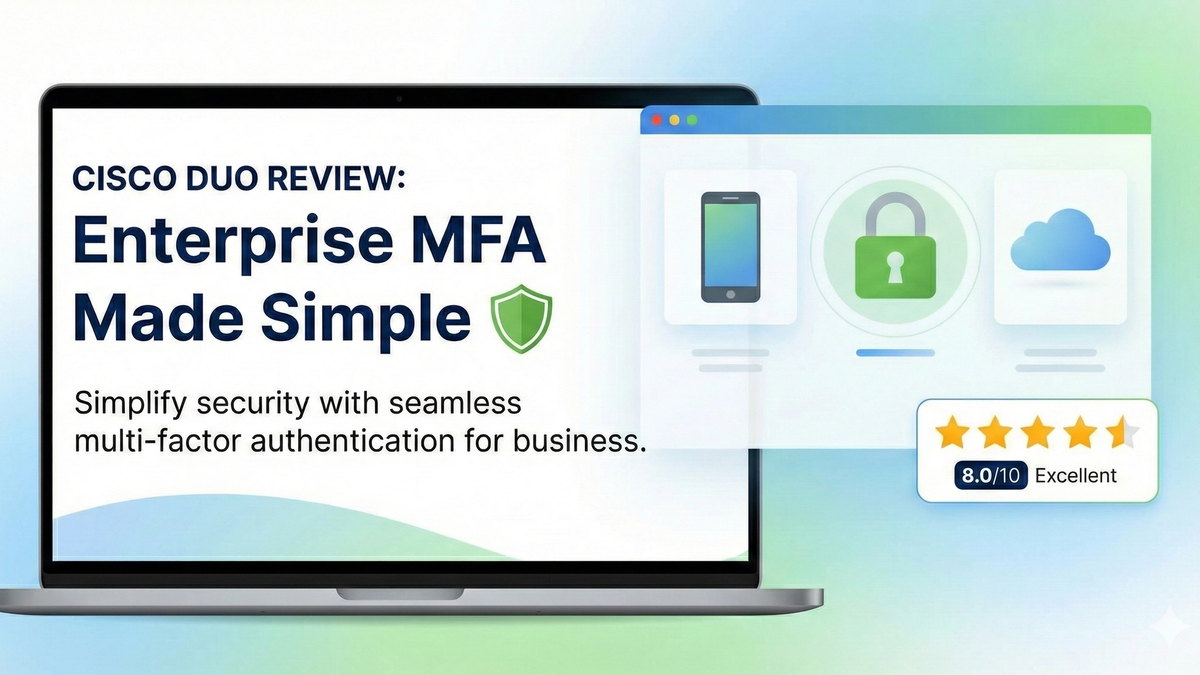
Cisco Duo Review: Enterprise MFA Made Simple
Cisco Duo delivers robust multi-factor authentication with one of the smoothest user experiences in the enterprise MFA space. While pricing can escalate quickly for larger teams, its device trust and adaptive policies make it a solid choice for security-conscious organizations.