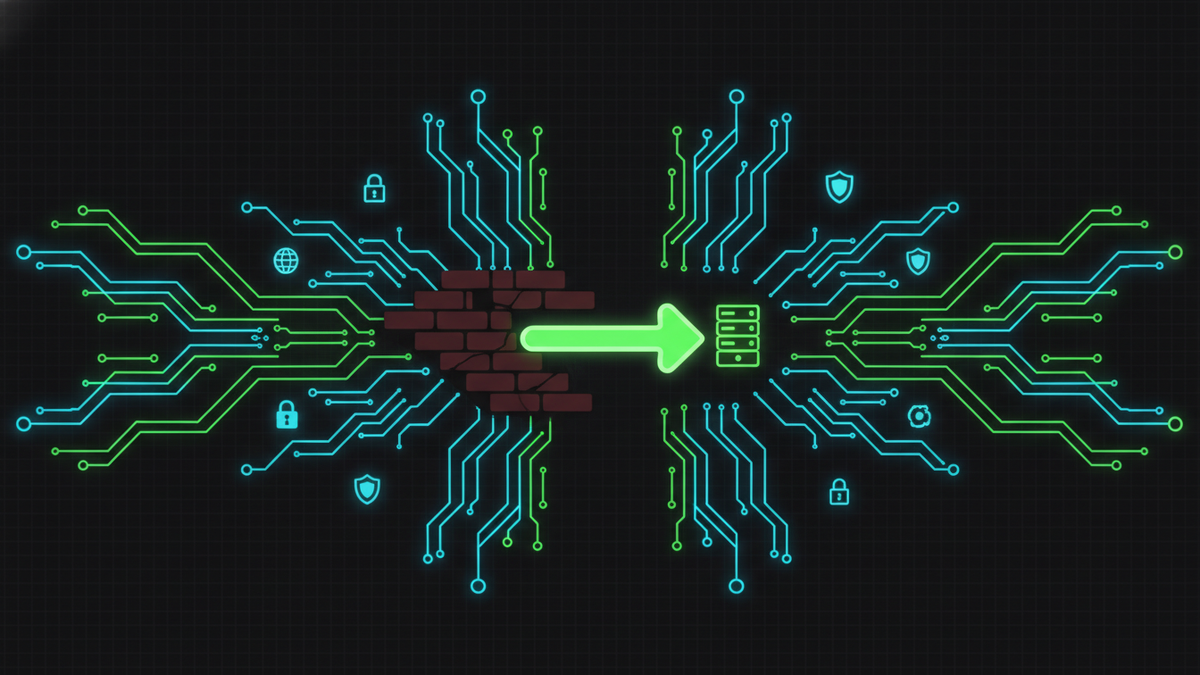
How SSRF Reaches Internal Services Behind the Perimeter
Server-side request forgery turns a server's network position into the attacker's. Why loopback-only services are the real target, and how to fix both ends of the chain.
Server-side request forgery is the vulnerabilityVulnerability🛡️A weakness in software, hardware, or processes that can be exploited by attackers to gain unauthorized access or cause harm. class behind both of this year's SonicWall SMA1000 zero-dayZero-Day🛡️A security vulnerability that is exploited or publicly disclosed before the software vendor can release a patchPatch🛡️A software update that fixes security vulnerabilities, bugs, or adds improvements to an existing program., giving developers 'zero days' to fix it. chains, including the CVE-2026-83548 campaign disclosed in September 2026. It is also one of the least intuitive classes for people who have not exploited it, because on paper it sounds harmless: the attacker makes the server send a request somewhere. The damage comes from where "somewhere" can be, and from what the receiving end assumes about a request that arrived from a trusted address.
The Core Mechanism
An SSRF exists whenever a server fetches, proxies, or forwards a request whose destination the client can influence, and the server does not adequately constrain that destination. The client cannot reach the target directly, but the server can, so the client borrows the server's network position.
Classic examples are webhook validators, "fetch this URL and preview it" features, image proxies, PDF renderers that follow links, and websocket or HTTP proxies built into appliances. Any of these becomes an SSRF the moment the destination check is missing, incomplete, or bypassable.
The two CWE identifiers CISA attached to the September SonicWall entry describe the two halves of the problem. CWE-918 is the forgery itself: the server was tricked into making a request. CWE-441 is "unintended proxy or intermediary," also called the confused deputy problem: a component with authority acts on behalf of a party that does not have that authority. An SSRF is dangerous precisely when it produces a confused deputy.
Why Appliances Are the Worst Case
A single-purpose network appliance is close to the ideal SSRF target, for structural reasons that have nothing to do with any one vendor.
An appliance bundles many services onto one operating system image: a public web front end for users, a separate management console for administrators, and a collection of internal control services that handle things like configuration, clustering, hotfix installation, and session state. To keep the internal services off the network, the vendor binds them to the loopback interface. The unstated assumption is that anything reaching 127.0.0.1 is already trusted code running on the box.
An SSRF in the public front end breaks that assumption completely. The July 2026 SonicWall chain, as documented by Rapid7, is a textbook case: the websocket proxy in the user portal let an unauthenticated client open a tunnel to arbitrary localhost-only services. Attackers used it to reach an Erlang process on the loopback interface and gained code execution as a service accountService Account🛡️A non-human operating system or application account under which a service runs. Its permissions define the blast radius of any exploitExploit🛡️Code or technique that takes advantage of a vulnerability to cause unintended behavior, such as gaining unauthorized access. against that service, since attacker code executes with the service account's access to files, secrets, and the network., then hit a control service on port 8188 whose hotfix-removal workflow trusted its input enough to allow a path traversal to root. The September chain has the same shape with a different front-end entry point and a different privileged sink in the management console.
Neither of the privileged services was "exposed" in any inventory. They were loopback-only, which is exactly why they had weak or no authentication. The SSRF made loopback-only meaningless.
The Attacker's View
From the outside, exploiting an SSRF is a search for the most valuable thing the server can reach that the attacker cannot. In rough order of value on a typical appliance or application host:
- Loopback services with no authentication, because the developers assumed only local code could reach them. Admin APIs, debug endpoints, message brokers, databases.
- Cloud instance metadataMetadata📖Data about data—like email timestamps, file sizes, or location tags on photos. endpoints, which hand out temporary credentials to anything that can reach the link-local address from inside the instance.
- Internal-network hosts behind the appliance, reachable because the appliance itself is on the trusted side of the firewallFirewall🌐Security system that monitors and controls network traffic based on predetermined rules..
- The server's own management interface, reached from the inside where IP allowlists no longer apply.
A "full" SSRF returns the response body to the attacker, which makes reconnaissance trivial. A "blind" SSRF does not, but timing differences and side effects (a request that triggers an action) still allow exploitation, just more slowly. Protocol smuggling is a further escalation: some URL parsers will let an attacker emit raw bytes to a non-HTTP service, turning a web request into a command to a database or a cache.
Defending the Source: Constrain the Request
If you write or operate software that makes outbound requests on a client's behalf, the fix is on the sending side.
Enforce an allowlist of destinations, resolved and checked after DNS resolution, not on the raw string. Denylists of private ranges fail to redirect tricks, DNS rebinding, and encoding games. Reject any scheme other than the one you need, disable redirects or re-validate each hop, and put a network egress policy behind the code so a logic bug cannot reach loopback, link-local, or internal ranges at all.
Defending the Sink: Stop Trusting Loopback
The more durable fix, and the one appliance vendors keep failing to apply, is on the receiving side. An internal service should authenticate its callers even when it only listens on 127.0.0.1. A signed request, a per-boot token in a root-only file, or a Unix domain socket with filesystem permissions all cost little and turn an SSRF from "root shell" into "connection refused." Path handling in any workflow that touches the filesystem must be canonicalized, because the July SonicWall root escalation was a path traversal in a hotfix-removal routine that had no reason to accept a traversal in the first place.
For operators who cannot change the appliance's code, the equivalent is to shrink what the appliance can reach and to watch what it reaches. Segment the appliance's internal interface so a compromised box cannot talk directly to domain controllers. Log its outbound connections off-box and alert on anything that is not its normal set of authentication and update destinations. Beazley's guidance for the September campaign, to monitor for anomalous outbound connections from the appliance, is exactly this control.
Where This Leads
An SSRF on its own rarely ends an incident. It is the first link, and its value is measured by the second link it can reach. In the SonicWall cases, the second link was root on a device that stores credentials and MFA seeds for an entire workforce, which is why the recovery process is so heavy; see How to Rebuild a Compromised VPN Appliance for that. And because the class is architectural rather than accidental, the same product tends to produce the same chain repeatedly, which is the argument made in Planning for Repeat Zero-Days in Remote-Access Appliances.
Related Reviews

REOLINK 4K Security Camera System Review: Professional PoE Surveillance at DIY Prices
The REOLINK 4K PoE security system delivers 8MP clarity, smart person/vehicle detection, 24/7 recording with 4TB storage, and plug-and-play installation for comprehensive home surveillance.
Ring Outdoor Cam Pro Review: 4K Security Camera with Radar-Powered Motion Detection
The Ring Outdoor Cam Pro delivers Retinal 4K video, 10x enhanced zoom, Low-Light Sight for true color night vision, and radar-powered 3D motion detection for precise security alerts.
Cisco Duo Review: Enterprise MFA Made Simple
Cisco Duo delivers robust multi-factor authentication with one of the smoothest user experiences in the enterprise MFA space. While pricing can escalate quickly for larger teams, its device trust and adaptive policies make it a solid choice for security-conscious organizations.